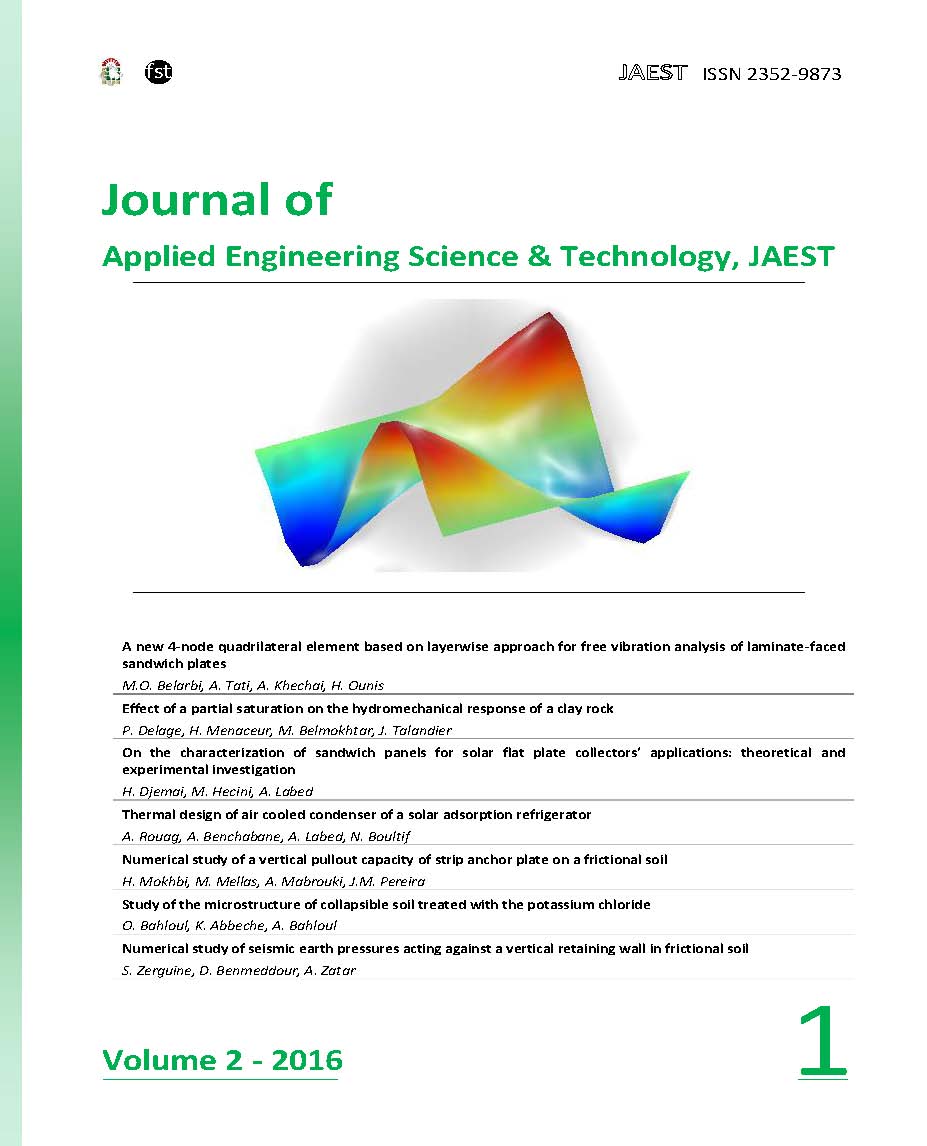
Numerical study of seismic earth pressures acting against a vertical retaining wall in frictional soil
 View 989/
 450
DOI:
https://doi.org/10.69717/jaest.v2.i1.31Keywords:
Retaining wall, Frictional soil, Seismic earth pressure, Finite element, PLAXISAbstract
The seismic earth pressures with presence of water, acting against a vertical retainingwall are often a function of many parameters. In the case of saturated sands, the earthquakecauses failure of the retaining wall resulting by soil liquefaction. The theoretical methods for thecalculation of seismic earth pressures available in literature remain unable to solve the envisagedproblems. In this study the finite element code PLAXIS is used to evaluate the active earth pressureacting against a vertical rigid retaining wall. The soil is modeled by an elasto-plastic model with aMohr-Coulomb yield criterion. In this study, several parameters have been considered in order toevaluate the effect of soil acceleration with transitory flow and hydrostatic groundwater. Theresults have been compared with those obtained by the pseudo-dynamic and pseudo-staticapproaches. The results show the influence of the seismic action on the earth pressures.
Downloads
Downloads
Published
Issue
Section
License

This work is licensed under a Creative Commons Attribution-NonCommercial 4.0 International License.
Copyright and Licensing Terms
Journal of Applied Engineering Science and Technology (JAEST)
Effective September 2026, JAEST adopted the Creative Commons Attribution 4.0 International License (CC BY 4.0) for newly published articles.
Under this license, readers may share, distribute, reproduce, adapt, and reuse published articles, including for commercial purposes, provided that appropriate credit is given to the original authors, the license is linked, and any changes are indicated.
Authors retain copyright of their work and grant JAEST the right of first publication.
Current Publication License: CC BY 4.0
Note on previously published articles: Articles published before September 2026 remain subject to their originally applicable licensing and copyright terms unless a change has been authorized by the respective rights holders. The current CC BY 4.0 policy does not automatically relicense previously published content.
For complete information, consult the JAEST Open Access Statement .