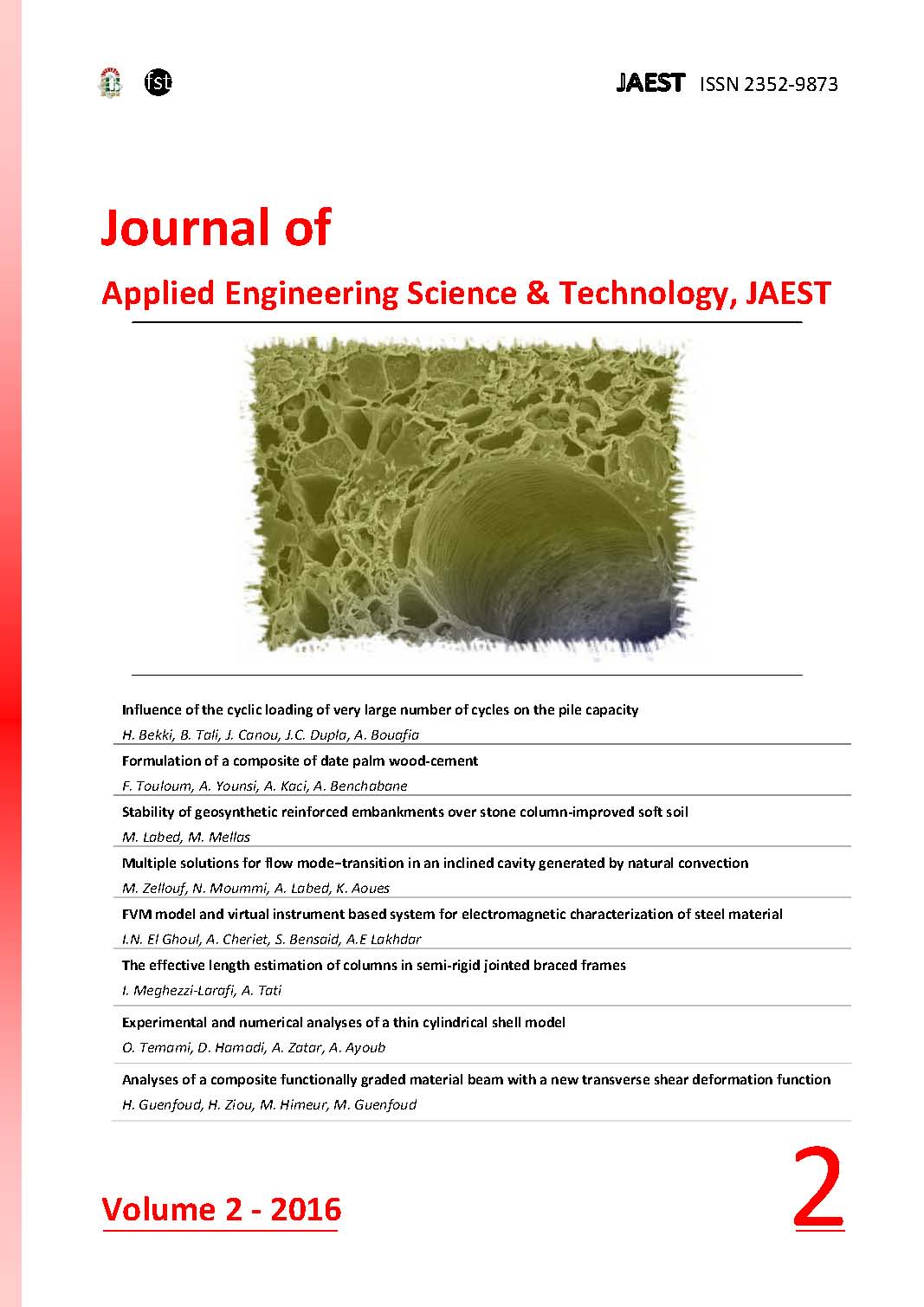
Experimental and numerical analyses of a thin cylindrical shell model
 View 1048/
 515
DOI:
https://doi.org/10.69717/jaest.v2.i2.39Keywords:
Experimental test, Cylindrical shell model, Flat shell element, Numerical analysisAbstract
The analysis of thin shell structures is generally based on theoretical principles. The
experimental tests on this type of structure are important for understanding the effect of loading
and the geometrical shapes on its mechanical behavior. In this paper, an experimental test of a
cylindrical shell under the effect of concentrated static loads is presented. A comparative
numerical study is carried out by using two finite elements: the first element called ACM_RSBE5,
recently formulated, and the second one, S4R, of ABAQUS code are used for the study of thin
shells. The experimental results are compared with those obtained numerically. The results of both
elements, ACM‐RSBE5 and S4R, are in agreement with those obtained experimentally. The
efficiency and the importance of the approach of the flat shell element for thin shell structures are
confirmed.
Downloads
Downloads
Published
Issue
Section
License

This work is licensed under a Creative Commons Attribution-NonCommercial 4.0 International License.
Copyright and Licensing Terms
Journal of Applied Engineering Science and Technology (JAEST)
Effective September 2026, JAEST adopted the Creative Commons Attribution 4.0 International License (CC BY 4.0) for newly published articles.
Under this license, readers may share, distribute, reproduce, adapt, and reuse published articles, including for commercial purposes, provided that appropriate credit is given to the original authors, the license is linked, and any changes are indicated.
Authors retain copyright of their work and grant JAEST the right of first publication.
Current Publication License: CC BY 4.0
Note on previously published articles: Articles published before September 2026 remain subject to their originally applicable licensing and copyright terms unless a change has been authorized by the respective rights holders. The current CC BY 4.0 policy does not automatically relicense previously published content.
For complete information, consult the JAEST Open Access Statement .