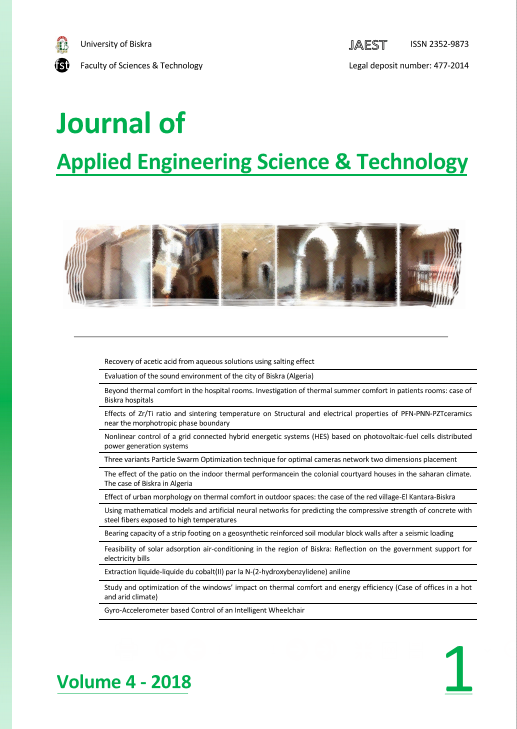
Feasibility of solar adsorption air-conditioning in the region of Biskra: Reflection on the government support for electricity bills
 View 618/
 492
DOI:
https://doi.org/10.69717/jaest.v4.i1.60Keywords:
Mono-split air conditioner, Centralized air conditioning chiller, Solar adsorption air conditioner, Government support, Billing electricityAbstract
In this paper, the feasibility of solar adsorption air conditioning system in the region ofBiskra (Algeria) is studied. The main objective is to give a reflection on the current governmentsupport for electricity bills. A comparison between three air conditioning systems was made bytaking into account economic and environmental constraints: classical mono-split system (A),classical centralized air conditioning chiller (B) and solar adsorption system (C). In the context ofthe current government support for electricity bills, results show that system A is actually thebest choice from the total investment costs, electrical consumption and maintenance point ofview. This is observed even with the gain of the electrical consumption obtained in the case ofsolar adsorption air conditioner (C). From an environmental point of view, the system (C) is moreadvantageous than the classical systems (A) & (B) especially for its use of the solar energy, its lowelectrical consumption, low CO2 emissions and low heat rejected to the outside. It can beconcluded that the current state policy do not encourage the transition to the use of airconditioning systems operate by renewable energies. Thus, the redirection of the current supportfor electricity bills to the support of the investment cost of the solar adsorption air conditioner(C) will make it more competitive in the Algerian market. In this case, system (C) can replace, inthe long-term, the system (A) used actually.
Downloads
Downloads
Published
Issue
Section
License

This work is licensed under a Creative Commons Attribution-NonCommercial 4.0 International License.
Copyright and Licensing Terms
Journal of Applied Engineering Science and Technology (JAEST)
Effective September 2026, JAEST adopted the Creative Commons Attribution 4.0 International License (CC BY 4.0) for newly published articles.
Under this license, readers may share, distribute, reproduce, adapt, and reuse published articles, including for commercial purposes, provided that appropriate credit is given to the original authors, the license is linked, and any changes are indicated.
Authors retain copyright of their work and grant JAEST the right of first publication.
Current Publication License: CC BY 4.0
Note on previously published articles: Articles published before September 2026 remain subject to their originally applicable licensing and copyright terms unless a change has been authorized by the respective rights holders. The current CC BY 4.0 policy does not automatically relicense previously published content.
For complete information, consult the JAEST Open Access Statement .