IoT-based smart street lighting system for reducing energy consumption
 View 491/
 183
0
DOI:
https://doi.org/10.69717/jaest.v6.i2.179Keywords:
Smart street lighting, IoT, ESP-NOW, Energy consumptionAbstract
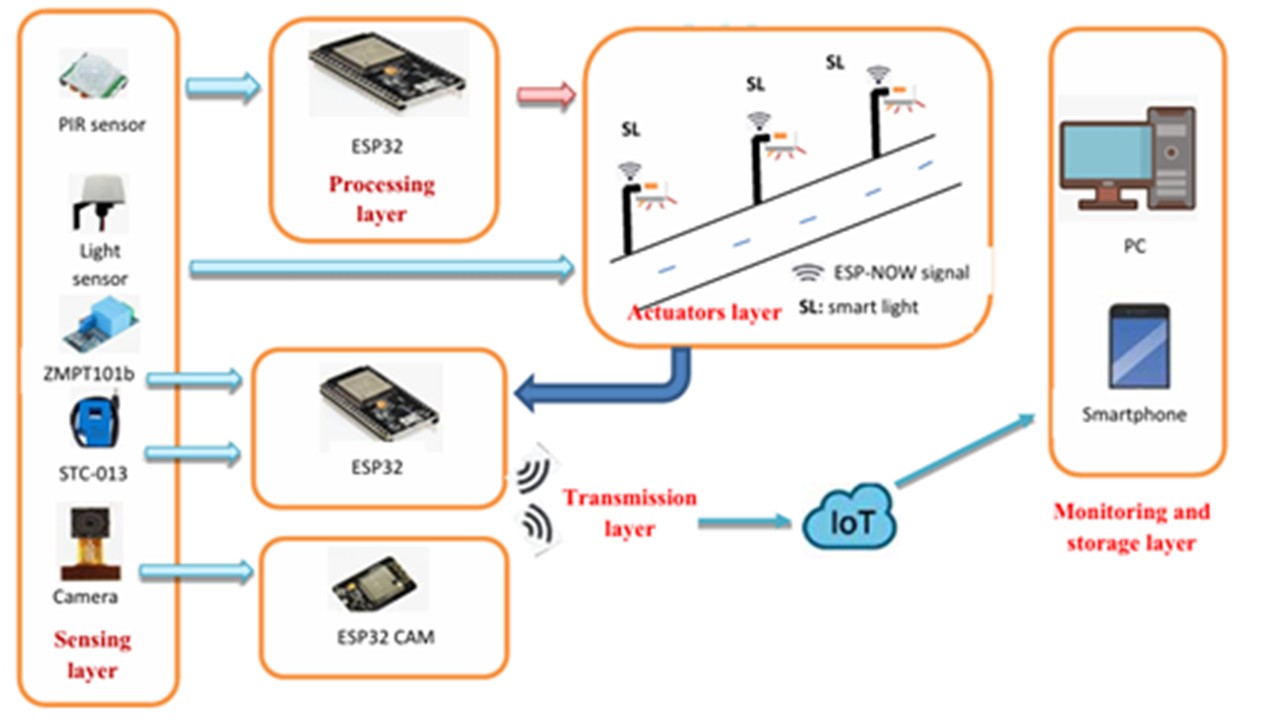
Street lighting systems are essential components of urban infrastructure due to their critical role in ensuring citizens’ safety, comfort, and quality of life. Moreover, they are among the largest consumers of energy in urban environments. This paper investigates the performance and feasibility of a prototype smart street lighting system based on the Internet of Things (IoT) and wireless communication technologies. The system was implemented and tested at a pilot site to improve energy efficiency. It provides adaptive lighting by ensuring that the area in front of the user is illuminated more brightly than the area behind them. This functionality is achieved through data exchange between lampposts using the ESP-NOW protocol. A passive infrared (PIR) sensor is used to detect user movement. Power consumption data are collected and stored on the ThingSpeak cloud platform, while street images are captured using an ESP32-CAM module and saved to Google Drive. The results demonstrate the effectiveness of the proposed system in reducing energy consumption, achieving a reduction rate of 49.54 % over three days of experimentation. Consequently, the system contributes to lower carbon dioxide (CO2) emissions and generates positive impacts on both people and the environment.
Highlights
Downloads
References
R. M'Hamed, B. Boussemaha, Y. Mouaadh, H. Youcef, M. Djelouli, Low cost of smart unilateral street lighting system with photovoltaic power plant using particle swarm optimization, Studies in Engineering and Exact Sciences 5 (2024) e11658. https://doi.org/10.54021/seesv5n2-656.
Y. Mouaadh, B. Bousmaha, R. M'Hamed, Intelligent control and reduce energy consumption of smart street lighting system, International Journal of Power Electronics and Drive Systems 13 (2022) 1966–1974. https://doi.org/10.11591/ijpeds.v13.i4.pp1966-1974.
M. Jackett, W. Frith, Quantifying the impact of road lighting on road safety – A New Zealand study, IATSS Research 36 (2013) 139–145. https://doi.org/10.1016/j.iatssr.2012.09.001.
S. Pizzuti, M. Annunziato, F. Moretti, Smart Street lighting management, Energy Efficiency 6 (2013) 607–616. https://doi.org/10.1007/s12053-013-9195-9.
S. Viswanathan, S. Momand, M. Fruten, A. Alcantar, A model for the assessment of energy-efficient smart street lighting – A case study, Energy Efficiency 14 (2021) 64. https://doi.org/10.1007/s12053-021-09957-w.
M. Beccali, V. Lo Brano, M. Bonomolo, P. Cicero, G. Corvisieri, M. Caruso, F. Gamberale, A multifunctional public lighting infrastructure, design and experimental test, Journal of Sustainable Development of Energy, Water and Environment Systems 5 (2017) 608–625. https://doi.org/10.13044/j.sdewes.d5.0164.
N. Abekiri, A. Rachdy, M. Ajaamoum, B. Nassiri, L. Elmahni, Y. Oubail, Platform for hands-on remote labs based on the ESP32 and NOD-red, Scientific African 19 (2023) e01502. https://doi.org/10.1016/j.sciaf.2022.e01502.
D. Mateos Matilla, Á. Lozano Murciego, D.M. Jiménez-Bravo, A.S. Mendes, V.R.Q. Leithardt, Low-cost edge computing devices and novel user interfaces for monitoring pivot irrigation systems based on Internet of Things and LoRaWAN technologies, Biosystems Engineering 223 (2022) 14–29. https://doi.org/10.1016/j.biosystemseng.2021.07.010.
L.O. Aghenta, M.T. Iqbal, Low-cost, open-source IoT-based SCADA system design using Thinger.io and ESP32 Thing, Electronics 8 (2019) 822. https://doi.org/10.3390/electronics8080822.
P.S. Macheso, D. Thotho, ESP32-based electric energy consumption meter, International Journal of Computer Communication and Informatics 4 (2022) 23–35. https://doi.org/10.34256/ijcci2213.
F. Sanchez-Sutil, A. Cano-Ortega, J.C. Hernandez, C. Rus-Casas, Development and calibration of an open-source, low-cost power smart meter prototype for PV household prosumers, Electronics 8 (2019) 878. https://doi.org/10.3390/electronics8080878.
Published
Issue
Section
License
Copyright (c) 2026 Journal of Applied Engineering Science and Technology

This work is licensed under a Creative Commons Attribution 4.0 International License.
Copyright and Licensing Terms
Journal of Applied Engineering Science and Technology (JAEST)
Effective September 2026, JAEST adopted the Creative Commons Attribution 4.0 International License (CC BY 4.0) for newly published articles.
Under this license, readers may share, distribute, reproduce, adapt, and reuse published articles, including for commercial purposes, provided that appropriate credit is given to the original authors, the license is linked, and any changes are indicated.
Authors retain copyright of their work and grant JAEST the right of first publication.
Current Publication License: CC BY 4.0
Note on previously published articles: Articles published before September 2026 remain subject to their originally applicable licensing and copyright terms unless a change has been authorized by the respective rights holders. The current CC BY 4.0 policy does not automatically relicense previously published content.
For complete information, consult the JAEST Open Access Statement .