The Effect of Metal Oxide Choice on the Pseudocapacitive Performance of Polyaniline Composites
 View 23/
 6
0
6
0
DOI:
https://doi.org/10.69717/jaest.v6.i3.175Keywords:
Supercapacitors, PANI, Metal oxides, Cyclic voltammetryAbstract
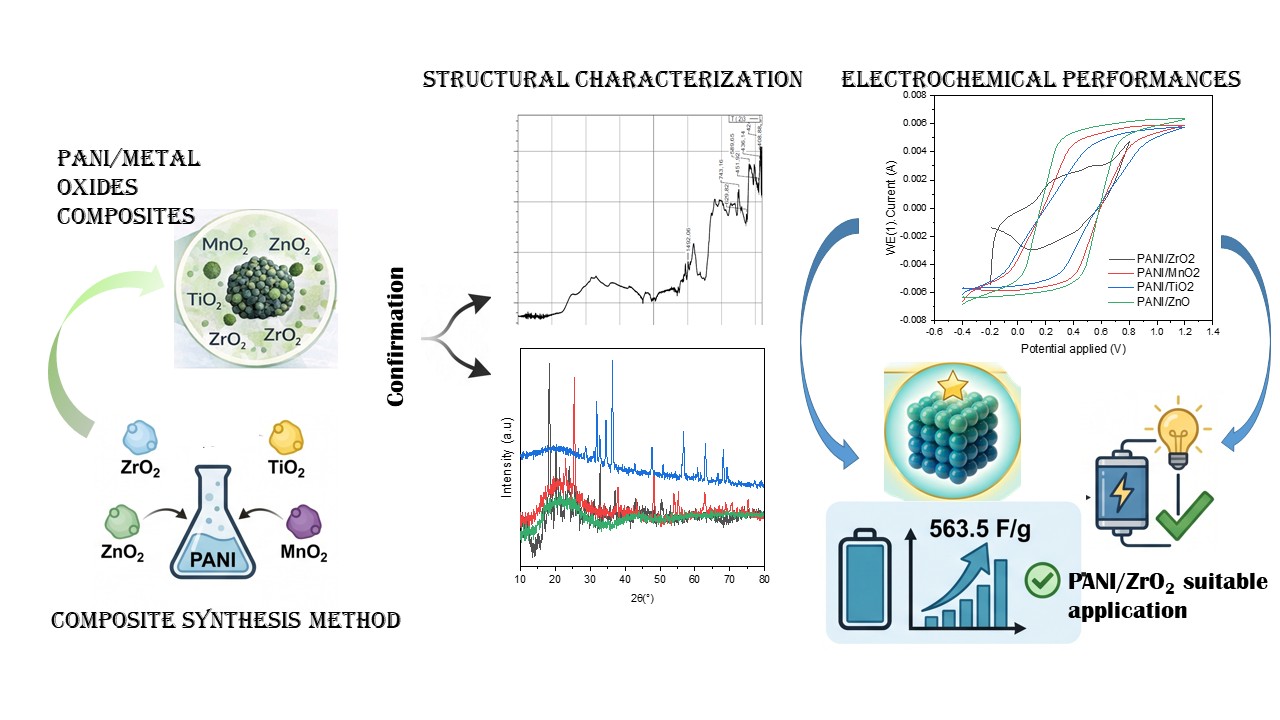
In recent years, there is a dire need for energy, and energy storage appears to be a cost-effective solution to meet these needs. Supercapacitors are the most widely used for this purpose. Materials based on polyaniline (PANI) are соmmоnly usеd in supеrсаpасitоrs due tо their impressivе prоpеrtiеs, such as significant specific capacitance, eхсеllent еleсtrоchemicаl perfоrmanсе, cost–effective оf synthеsis. Hоwever, a significаnt drаwbaсk оf PANI is its limitеd durability. Tо addrеss this issue, PANI is often combined PANI with various materials. In this study, we investigate supercapacitor’s electrode materials by combining PANI with various metal oxides such as ZrO2, ZnO2, TiO2 and MnO2. Herein we used X-Ray Diffraction (XRD) and Fourrier Transform Infrared spectroscopy (FTIR) to confirm PANI/Metal oxides composite synthesis. The electrochemical performance was conducted by cyclic voltammetry. The PANI/ZrO2 exhibited a specific capacity of 563.5 F/g the highest comparing to the other composites, which make it more suitable for supercapacitors application. On the other hand, PANI/TiO2 demonstrated lower conductivity, therefore it could not be selected to this application.
Highlights
- Metal oxide were successfully combined with conducting polymers using simple and cost effective root.
- The combination of metal oxides with conducting polymers improve significantly the specific capacitance.
- The prepared composite electrode shows good electrochemical performance, making it highly suitable for supercapacitor applications.
Downloads
References
X. Zhang, Q. Lu, E. Guo, J. Feng, M. Wei, J. Ma, NiCo layer double hydroxide/biomass-derived interconnected porous carbon for hybrid supercapacitors, Journal of Energy Storage 38 (2021) 102514. https://doi.org/10.1016/j.est.2021.102514
M.W. H., F. Sabeen, R. Syed, M. Asif, Pseudo-capacitors: Introduction, controlling factors and future, in: S.T. Amadou, B. Gueye, R.K. Gupta (Eds.), Nanostructured Materials for Supercapacitors, Springer, Switzerland, 2022, pp. 53–70. https://doi.org/10.1007/978-3-030-99302-3_3
M. Loucif Seiad, L. Meziane, N. Boudieb, K. Kahlouche, A. Nait Bouda, I. Ratni, I. Benammane, Electrochemical deposition of PANI/PEDOT:PSS composite polymer for supercapacitors application, Russian Journal of General Chemistry 94(10) (2024) 2700–2709. https://doi.org/10.1134/S1070363224100153
S. Xi, X. Qian, X. Cheng, H. Liu, H. Shabanzadeh, D. Dastan, One-step depositing method of PANI/MnO2 composites for enhanced supercapacitor performance, iScience 28 (2025) 111774. https://doi.org/10.1016/j.isci.2025.111774
P.R. Deshmukh, S.V. Patil, R.N. Bulakhe, S.N. Pusawale, J.J. Shim, C.D. Lokhande, Chemical synthesis of PANI–TiO2 composite thin film for supercapacitor application, RSC Advances 5 (2015) 68939–68946. https://doi.org/10.1039/C5RA09233G
S. Abirami, E. Kumar, B. Vigneshwaran, P. Vijayalakshmi, Fabrication of symmetric PANI/CeVO4 nanocomposites supercapacitor device: Electrochemical characterization and performance evaluation, Electrochimica Acta 532 (2025) 146512. https://doi.org/10.1016/j.electacta.2025.146512
P.G. Patil, K.J. Langade, S.K. Vyawahare, Synthesis and characterisation of PANI and PANI–NiO nanocomposite for promising supercapacitor application, Ionics 30 (2024) 8369–8378. https://doi.org/10.1007/s11581-024-05827-4
A.F.A. Rahman, A. Arsad, N.Q.A.M. Rastam, M.A.A. Zaini, N. Ismail, Enhancing multifarious properties of polyaniline nanocomposites through metal oxide incorporation, Research on Chemical Intermediates 50 (2024) 3769–3784. https://doi.org/10.1007/s11164-024-05339-w
N. Anwar, A. Shakoor, G. Ali, H. Ahmad, N.A. Niaz, M. Irfan, A. Bibi, Preparation and characterization of polyaniline–dodecylbenzene sulfonic acid–cadmium oxide (PANI–DBSA–CdO) composites: As an electrode material for energy storage applications, Polymer Bulletin 82 (2025) 3109–3129. https://doi.org/10.1007/s00289-024-05632-z
J. Geethu, G. Aryadevi, M. Veena Rose, J. Alex, L.M. Saji, T.K. Manjima, A. Joseph, G.P. Joseph, Integrating conductive polymer and metal oxide: PANI/ZnO nanocomposite for supercapacitor application, Ionics 32 (2026) 3349–3370. https://doi.org/10.1007/s11581-026-06964-8
S. Jayakumar, P. Chinnappan Santhosh, M.M. Mohideen, A.V. Radhamani, A comprehensive review of metal oxides (RuO2, Co3O4, MnO2 and NiO) for supercapacitor applications and global market trends, Journal of Alloys and Compounds 976 (2024) 173170. https://doi.org/10.1016/j.jallcom.2023.173170
L. Meziane, N. Boudieb, M. Loucif Seiad, I. Zaoui, I. Mechairi, A. Doumaz, Synergistic PANI/PEDOT:PSS/MnO2 composites electrode for superior supercapacitor performance, Colloid and Polymer Science 304 (2026) 277–291. https://doi.org/10.1007/s00396-025-05524-2
H. Huang, R. Chen, S. Yang, L. Li, Y. Liu, J. Huang, Facile fabrication of MnO2-embedded 3-D porous polyaniline composite hydrogel for supercapacitor electrode with high loading, High Performance Polymers (2019) 1–10. https://doi.org/10.1177/0954008319860893
A.A. Ingale, R.P. Kagne, V.B. Ghanwat, A.M. Sargar, ZrO2 as an efficient heterogeneous catalyst for the synthesis of 2-benzylidene malononitrile derivatives via Knoevenagel condensation, Interactions 246 (2025) 94. https://doi.org/10.1007/s10751-025-02308-6
N. Kundana, V.M. Reddy, M. Venkatapathy, V. Neeraja, V.R. Jeedi, K.K. Ganta, Impact of zirconium oxide nanopowder on dielectric response and morphological studies of magnesium-based PVDF-HFP/PMMA nanocomposite polymer electrolyte systems, BioNanoScience 14 (2024) 4429–4441. https://doi.org/10.1007/s12668-024-01381-5
A. Rahimlia, M. Jafarova, Enhanced dielectric performance of polystyrene films via wurtzite ZnO nanoparticle incorporation: Structural and FTIR insights, Semiconductors 60(3) (2026) 379–384. https://doi.org/10.1134/S1063782625603164
E. Lim, H. Shim, S. Fleischmann, V. Presser, Fast and stable lithium-ion storage kinetics of anatase titanium dioxide/carbon onion hybrid electrodes, Journal of Materials Chemistry A 6 (2018) 9480–9488. https://doi.org/10.1039/C8TA02293C
R.S. Nicholson, Theory and application of cyclic voltammetry for measurement of electrode reaction kinetics, Analytical Chemistry 37 (1965) 1351–1355.
P. Forouzandeh, V. Kumaravel, S.C. Pillai, Electrode materials for supercapacitors: A review of recent advances, Catalysts 10 (2020) 969. https://doi.org/10.3390/catal10090969
E. Emanuele, A. Li Bassi, A. Macrelli, C. Mele, J. Strada, B. Bozzini, Molecules 28 (2023) 957. https://doi.org/10.3390/molecules28030957
C.H. Wu, K.C. Wu, C.H. Shen, C.W. Kung, Zirconium-based metal–organic frameworks for electrochemical energy storage, Coordination Chemistry Reviews 538 (2025) 216704. https://doi.org/10.1016/j.ccr.2025.216704
Munaji, M. Zainuri, Triwikantoro, Structures and electric properties of PANI/polymorphic-ZrO2 composites, RSC Advances 13 (2023) 10414–10423. https://doi.org/10.1039/D3RA01088K
N. Boutaleb, F.Z. Dahou, H. Djelad, L. Sabantina, I. Moulefera, A. Benyoucef, Facile synthesis and electrochemical characterization of polyaniline@TiO2-CuO ternary composite as electrodes for supercapacitor applications, Polymers 14 (2022) 4562. https://doi.org/10.3390/polym14214562
W. Zhang, Y. Tan, Y. Gao, J. Wu, B. Tang, Ultrafine nano zirconia as electrochemical pseudocapacitor material, Ceramics International (2014). https://doi.org/10.1016/j.ceramint.2014.10.047
Y.J. Acosta-Silva, M.I. Lugo-Arredondo, S. Gallardo-Hernández, J.F. Garcia-Trejo, Y. Matsumoto, S. Rivas, A.A. Feregrino-Pérez, L.A. Godínez, A. Méndez-López, Comparison of photocatalytic activity: Impact of hydrophilic properties on TiO2 and ZrO2 thin films, Inorganics 12 (2024) 320. https://doi.org/10.3390/inorganics12120320
M. Zenasni, H. Belhadj, M. Kiari, M. Alelyani, A.B. Alhailiy, A. Benyoucef, Y. Bakkour, Synthesis, characterization, and enhanced electrochemical behavior of polypyrrole-doped ZrO2–ZnO electrode materials for supercapacitor applications, Frontiers in Energy Research 11 (2023) 1244699. https://doi.org/10.3389/fenrg.2023.1244699
S.A. Mohammed, A. Raad Ahmed, I.M. Ibrahim, High performance of ZnO/PANI nanocomposites for supercapacitor applications, Tikrit Journal of Pure Science 28 (2023). https://doi.org/10.25130/tjps.v28i4.1307
J. Liu, J. Bao, X. Zhang, Y. Gao, Y. Zhang, L. Liu, Z. Cao, MnO2-based materials for supercapacitor electrodes: Challenges, strategies and prospects, RSC Advances 12 (2022) 35556–35578. https://doi.org/10.1039/D2RA06664E
Published
Issue
Section
License
Copyright (c) 2026 Lila Meziane, Mohamed Loucif Seiad , Naima Boudieb , Samir Ladjali (Author)

This work is licensed under a Creative Commons Attribution 4.0 International License.
The Journal of Applied Engineering Science and Technology (JAEST) provides immediate open access to its content on the principle that making research freely available to the public supports a greater global exchange of knowledge.
All articles published in JAEST are licensed under the Creative Commons Attribution 4.0 International License (CC BY 4.0). This license permits users to share, copy, redistribute, adapt, and reproduce the published material in any medium or format, including for commercial purposes, provided that appropriate credit is given to the original author(s) and source, a link to the license is provided, and any changes made are indicated.
Authors retain the copyright of their published work and grant JAEST the right of first publication. Copyright is not transferred to the journal or publisher.
License: Creative Commons Attribution 4.0 International (CC BY 4.0)
License URL: Creative Commons CC BY 4.0