Band gap engineering in Silicene NanoRibbon by hydrogen edge–termination :Atheoretical study of ab initio Density functional theory DFT
 View 56/
 19
0
19
0
DOI:
https://doi.org/10.69717/jaest.v6.i3.154Keywords:
Density functional theory, Electronic properties, Silicene NanoRibbon, Localized edge stateAbstract
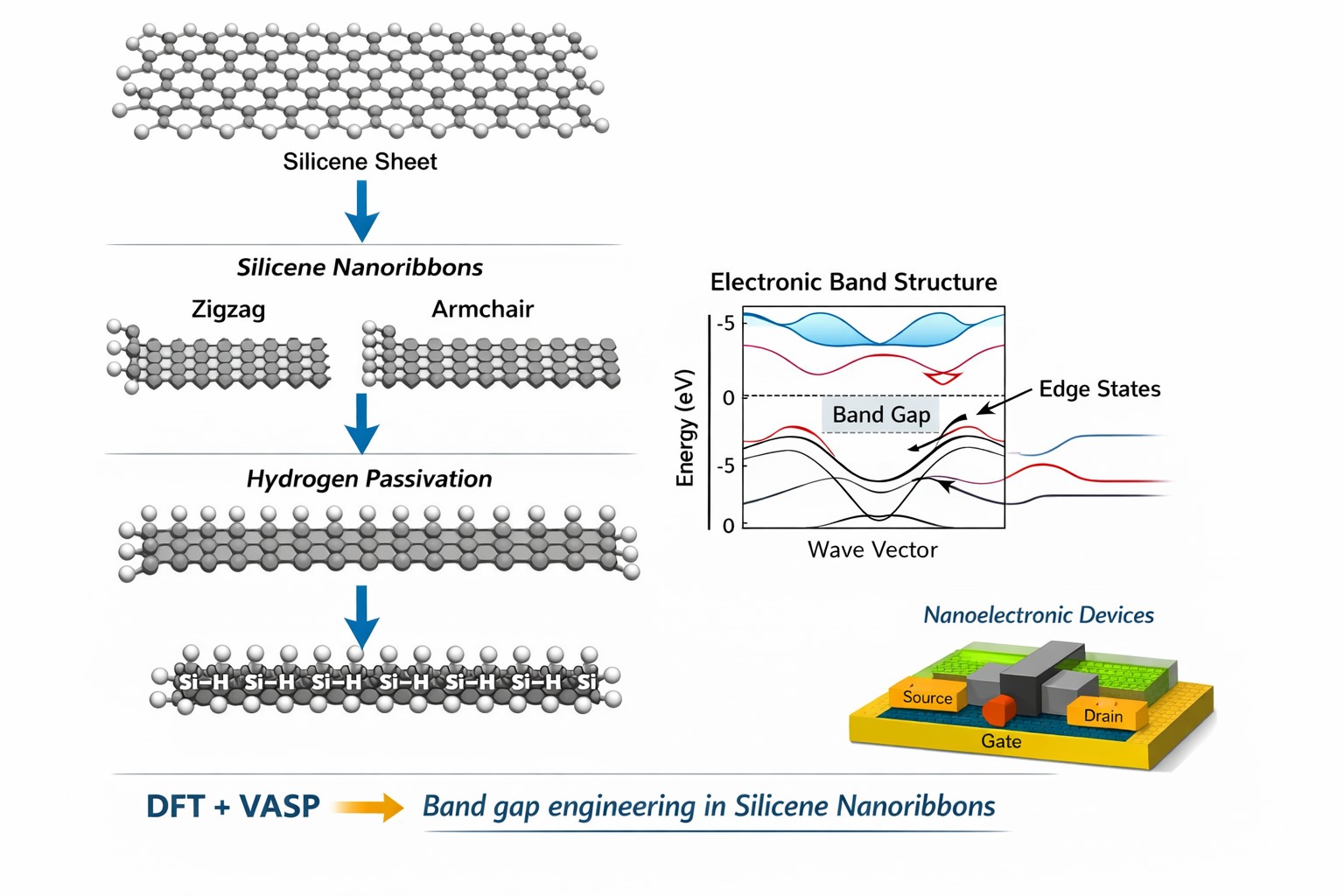
In this work, utilizing the ab initio Density functional theory DFT, we aim to study the
impacts hydrogen H edge atom passivation on the structural, stability and electronic properties of
planar bare (without H- edge passivation) Silicene NanoRibbon (PLSiNRs) with either zigzag
(PLZSiNRs) or armchair (PLASiNRs) edges on both sides. We found that the edge Si–Si bonds are
shorter than the inner ones with identical orientation, implying a contraction relaxation of edge Si atoms but the length of the Si–H bond is always 1.5 A°. Our calculations demonstrated existence of flat bands which cause metallicity in PLZSiNRs- with appearance of a nearly flat band in the ZSiNRs edges near the Fermi level, indicating the presence of a localized edge state. Clearly all PLASiNR-H are nonmagnetic semiconductors with controllable band gaps depending on the ribbon’s width.The band gaps of PLASiNRs–H present oscillatory behavior and can be classified into three
branches Eg(3n +1) > Eg(3n) > Eg(3n +2), where n is an integer. Our results provide that the edge hydrogenation(-H) can be used to tune the structural, stability and electronic properties of a bare PLSiNRs and it is a key issue to integrate PLZSiNRs-H and PLASiNR-H integrate electronic devices like field-effect transistors (FETs) and energy materials.
Highlights
- Electronic properties of silicene armchair nanoribbons were investigated.
- Density functional theory calculations were performed using VASP.
- Edge passivation significantly modifies the band gap of the nanoribbons.
- Magnetic behavior depends on ribbon width and edge configuration.
- Results suggest promising applications in nanoelectronic devices.
Downloads
References
M. Houssa, A. Dimoulas, A. Molle, Silicene: A review of recent experimental and theoretical investigations, J. Phys. Condens. Matter 27 (2015) 253002. https://doi.org/10.1088/0953-8984/27/25/253002
S. Cahangirov, M. Topsakal, E. Aktürk, H. Şahin, S. Ciraci, Two- and one-dimensional honeycomb structures of silicon and germanium, Phys. Rev. Lett. 102 (2009) 236804. https://doi.org/10.1103/PhysRevLett.102.236804
L. Tao, E. Cinquanta, D. Chiappe, C. Grazianetti, M. Fanciulli, M. Dubey, A. Molle, D. Akinwande, Silicene field-effect transistors operating at room temperature, Nat. Nanotechnol. 10 (2015) 227–231. https://doi.org/10.1038/nnano.2014.325
M.R. Tchalala, H. Enriquez, A.J. Mayne, A. Kara, S. Roth, M.G. Silly, A. Bendounan, F. Sirotti, T. Greber, B. Aufray, G. Dujardin, M.A. Ali, H. Oughaddou, Formation of one-dimensional self-assembled silicon nanoribbons on Au(110)-(2 × 1), Appl. Phys. Lett. 102 (2013) 083107. https://doi.org/10.1063/1.4793536
P. De Padova, C. Quaresima, B. Olivieri, P. Perfetti, G. Le Lay, Strong resistance of silicene nanoribbons towards oxidation, J. Phys. D: Appl. Phys. 44 (2011) 312001. https://doi.org/10.1088/0022-3727/44/31/312001
M. DavoodianIdalik, A. Kordbacheh, N. Ghasemi, Electronic, magnetic and transport properties of silicene armchair nanoribbons substituted with monomer and dimer of Fe atom, AIP Adv. 8 (2018) 065207. https://doi.org/10.1063/1.5029426
S.M. Aghaei, M.M. Monshi, I. Torres, I. Calizo, Edge functionalization and doping effects on the stability, electronic and magnetic properties of silicene nanoribbons, RSC Adv. 6 (2016) 17046–17058. https://doi.org/10.1039/C5RA26107D
M.M. Monshi, S.M. Aghaei, I. Calizo, Edge functionalized germanene nanoribbons: Impact on electronic and magnetic properties, RSC Adv. 7 (2017) 18900–18908. https://doi.org/10.1039/C6RA25083A
G. Kresse, D. Joubert, From ultrasoft pseudopotentials to the projector augmented-wave method, Phys. Rev. B 59 (1999) 1758–1775. https://doi.org/10.1103/PhysRevB.59.1758
D. Vanderbilt, Soft self-consistent pseudopotentials in a generalized eigenvalue formalism, Phys. Rev. B 41 (1990) 7892–7895. https://doi.org/10.1103/PhysRevB.41.7892
J.P. Perdew, K. Burke, M. Ernzerhof, Generalized Gradient Approximation Made Simple, Phys. Rev. Lett. 77 (1996) 3865–3868. https://doi.org/10.1103/PhysRevLett.77.3865
S.M. Aghaei, I. Calizo, Band gap tuning of armchair silicene nanoribbons using periodic hexagonal holes, J. Appl. Phys. 118 (2015) 104304. https://doi.org/10.1063/1.4930139
K. Nakada, M. Fujita, G. Dresselhaus, M.S. Dresselhaus, Edge state in graphene ribbons: Nanometer size effect and edge shape dependence, Phys. Rev. B 54 (1996) 17954–17961. https://doi.org/10.1103/PhysRevB.54.17954
Y. Feng, B.-J. Feng, Z.-J. Xie, W.-B. Li, X. Liu, D.-F. Liu, L. Zhao, L. Chen, X.-J. Zhou, K.-H. Wu, Observation of a flat band in silicene, Chin. Phys. Lett. 31 (2014) 127303. https://doi.org/10.1088/0256-307X/31/12/127303
Published
Issue
Section
License
Copyright (c) 2026 Issam djabri, Rafik Belghit, Mohammed Tahar Kadri, Hafid Belkhir (Author)

This work is licensed under a Creative Commons Attribution 4.0 International License.
The Journal of Applied Engineering Science and Technology (JAEST) provides immediate open access to its content on the principle that making research freely available to the public supports a greater global exchange of knowledge.
All articles published in JAEST are licensed under the Creative Commons Attribution 4.0 International License (CC BY 4.0). This license permits users to share, copy, redistribute, adapt, and reproduce the published material in any medium or format, including for commercial purposes, provided that appropriate credit is given to the original author(s) and source, a link to the license is provided, and any changes made are indicated.
Authors retain the copyright of their published work and grant JAEST the right of first publication. Copyright is not transferred to the journal or publisher.
License: Creative Commons Attribution 4.0 International (CC BY 4.0)
License URL: Creative Commons CC BY 4.0