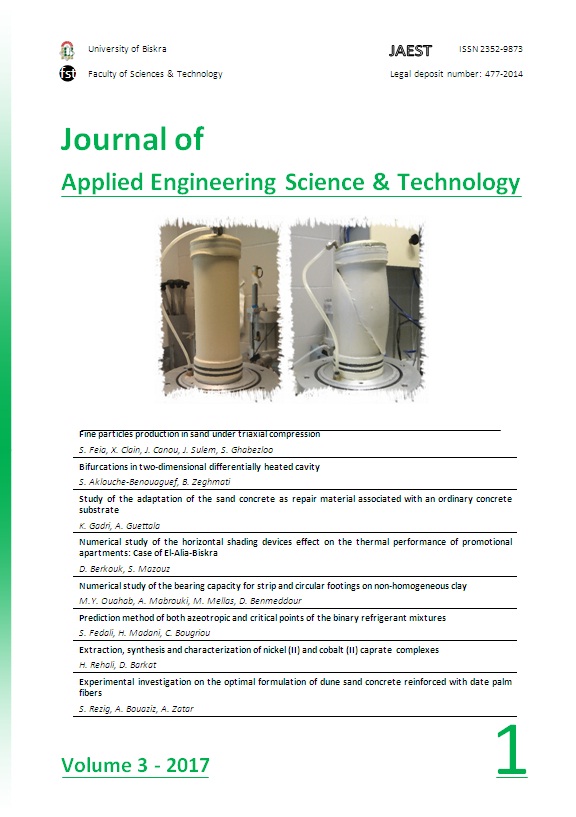
Study of the adaptation of the sand concrete as repair material associated with an ordinary concrete substrate
 View 664/
 0
422
DOI:
https://doi.org/10.69717/jaest.v3.i1.48Keywords:
Sand concrete, Crushed sand, Substrate, Repair concrete, Elastic modulus, Bond strengthAbstract
In this paper, a particular importance is given to the sand concrete as a new repairmaterial. A study is conducted to evaluate its mechanical and physical properties. By targeting thecompactness and workability, three crushed sand concrete series were made from a fixed choiceof the cement content. Once the sand concrete intended for repair is chosen; its characterization isrealized by mechanical and physical tests, namely compression and splitting tensile, measurementof modulus of elasticity and the shrinkage. A repair simulation is applied on half-cylinders ofordinary concrete with two ranges of strength, (BO40) and (BO25). The substrates are preparedwith two surfaces of different textures: roughness (RIG) and surface with drilled holes (PER). Thebond strength and its quality are determined by a splitting tensile test. The result showed asignificant improvement in mechanical strength, a low elastic modulus of 21315 MPa and amoderate shrinkage of 426μm/m after 28 days. Similarly, significant bond strength is recordedbetween sand concrete and ordinary concrete, reflecting a good adhesion with the substrate
Downloads
Downloads
Published
Issue
Section
License

This work is licensed under a Creative Commons Attribution-NonCommercial 4.0 International License.
Copyright and Licensing Terms
Journal of Applied Engineering Science and Technology (JAEST)
Effective September 2026, JAEST adopted the Creative Commons Attribution 4.0 International License (CC BY 4.0) for newly published articles.
Under this license, readers may share, distribute, reproduce, adapt, and reuse published articles, including for commercial purposes, provided that appropriate credit is given to the original authors, the license is linked, and any changes are indicated.
Authors retain copyright of their work and grant JAEST the right of first publication.
Current Publication License: CC BY 4.0
Note on previously published articles: Articles published before September 2026 remain subject to their originally applicable licensing and copyright terms unless a change has been authorized by the respective rights holders. The current CC BY 4.0 policy does not automatically relicense previously published content.
For complete information, consult the JAEST Open Access Statement .