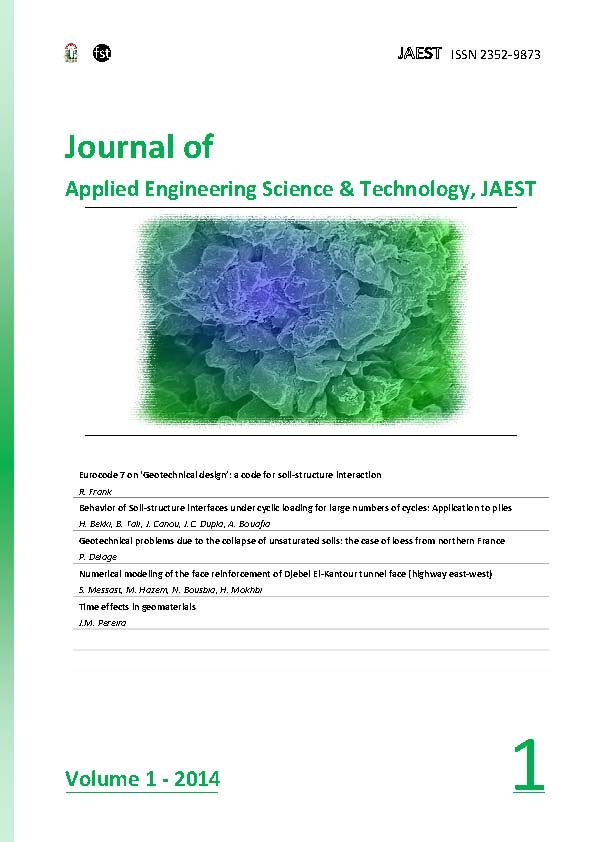
Behavior of Soil-structure interfaces under cyclic loading for large numbers of cycles: Application to piles
 View 770/
 400
DOI:
https://doi.org/10.69717/jaest.v1.i1.12Keywords:
Calibration chamber, pile, soil, interface, skin friction, cyclic loadingAbstract
Pile foundations are usually subjected to cyclic loading which can be either environmental or industrial. Loading and unloading sequences of the pile cause very significant variation in the behavior of the pile-soil system and generate degradation of the bearing capacity and an accumulation of irreversible displacement. The paper presents a study of the behavior of piles subjected to axial cyclic loading for large numbers of cycles using a physical modeling approach in a calibration chamber. To focus on the degradation of the friction in soil-pile interface, the experiments are carried out in two-way displacement–controlled tests. Firstly, The experimental set-up was presented, then the typical results of the evolution of skin friction under cyclic loading. The results indicate that the application of a large number of cycles to the pile, the skin friction decrease initially then increase continually up to the end of the cyclic sequence. It can be concluded that the phase of friction reinforcement is due to a partially constrained dilatancy phenomenon of the sand within the interface zone.
Downloads
Downloads
Published
Issue
Section
License

This work is licensed under a Creative Commons Attribution-NonCommercial 4.0 International License.
Copyright and Licensing Terms
Journal of Applied Engineering Science and Technology (JAEST)
Effective September 2026, JAEST adopted the Creative Commons Attribution 4.0 International License (CC BY 4.0) for newly published articles.
Under this license, readers may share, distribute, reproduce, adapt, and reuse published articles, including for commercial purposes, provided that appropriate credit is given to the original authors, the license is linked, and any changes are indicated.
Authors retain copyright of their work and grant JAEST the right of first publication.
Current Publication License: CC BY 4.0
Note on previously published articles: Articles published before September 2026 remain subject to their originally applicable licensing and copyright terms unless a change has been authorized by the respective rights holders. The current CC BY 4.0 policy does not automatically relicense previously published content.
For complete information, consult the JAEST Open Access Statement .