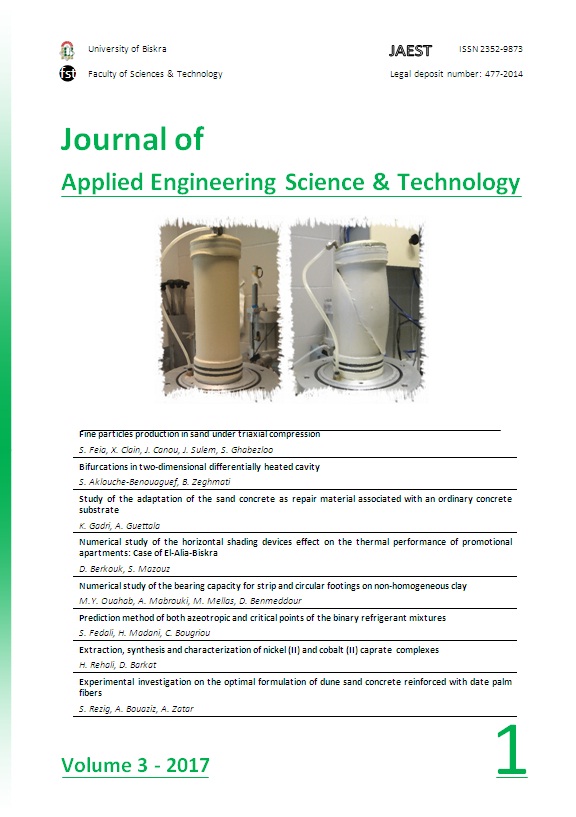
Prediction method of both azeotropic and critical points of the binary refrigerant mixtures
 View 667/
 471
DOI:
https://doi.org/10.69717/jaest.v3.i1.50Keywords:
Critical point, Azeotropic point, Binary mixtures, Refrigerant, Equation of state, R134aAbstract
The prediction of the azeotropic point and the determination of the critical point inbinary mixtures is very important in refrigerating industry. In this task, a simple method ispresented in order to predict and determine both azeotropic and critical points. Our methodemploys experimental data and a thermodynamic model. 1,1,1,2‐tetrafluoroethane (R134a) in themixture presents the possibility of inventing the azeotropic and critical properties. The mixturesstudied in this work are: Cyclopropane (RC270), Propylene (R1270), Hexafluoroethane (R116) andCarbon dioxide (R744) based on 1,1,1,2‐tetrafluoroethane (R134a). The model consists of thePeng–Robinson equation of state (EoS), the Mathias–Copeman alph a function and the Wong‐Sandler mixing rules involving the NRTL model. The results proved that there is a good agreementbetween the predicted values and the experimental data. The presented methods are able topredict the azeotropic and determine critical positions.
Downloads
Downloads
Published
Issue
Section
License

This work is licensed under a Creative Commons Attribution-NonCommercial 4.0 International License.
Copyright and Licensing Terms
Journal of Applied Engineering Science and Technology (JAEST)
Effective September 2026, JAEST adopted the Creative Commons Attribution 4.0 International License (CC BY 4.0) for newly published articles.
Under this license, readers may share, distribute, reproduce, adapt, and reuse published articles, including for commercial purposes, provided that appropriate credit is given to the original authors, the license is linked, and any changes are indicated.
Authors retain copyright of their work and grant JAEST the right of first publication.
Current Publication License: CC BY 4.0
Note on previously published articles: Articles published before September 2026 remain subject to their originally applicable licensing and copyright terms unless a change has been authorized by the respective rights holders. The current CC BY 4.0 policy does not automatically relicense previously published content.
For complete information, consult the JAEST Open Access Statement .