Influence of Creepage Distance and Pollution Severity on Flashover Voltage and Parallel Discharge Mechanisms in Glass Insulators
 View 24/
 12
0
12
0
DOI:
https://doi.org/10.69717/jaest.v6.i3.172Keywords:
Discharges, Voltage, Glass, Plane, Creepage distance, InsulatorAbstract
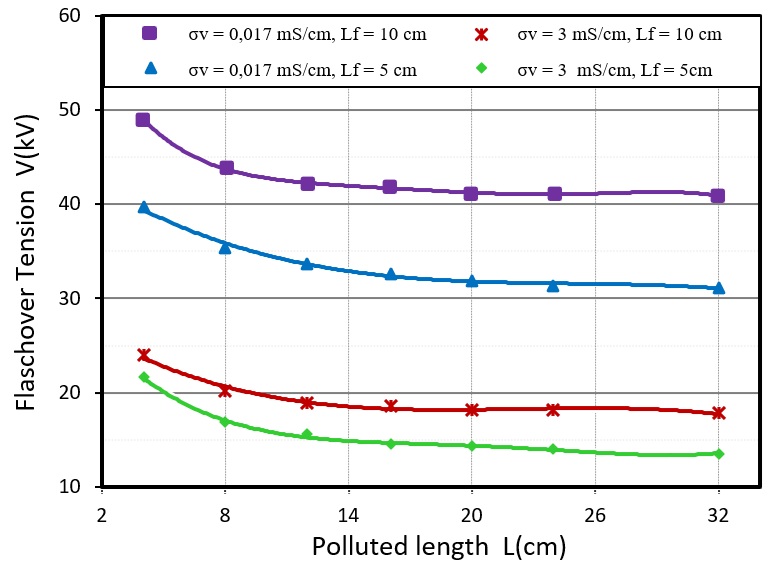
This study investigates the impact of creepage distance and insulator geometry on the AC flashover voltage (FOV) and parallel-discharge characteristics of flat-glass insulator models under uniform pollution conditions. Experimental tests were conducted using a plane-plane electrode configuration with pollution conductivities ranging from 17 μS/cm to 10 mS/cm. The results demonstrate that increasing the creepage distance consistently elevates the flashover voltage by forming multiple distinct dry bands, thereby increasing overall dielectric resistance. Furthermore, while an increased insulator diameter reduces total surface resistance, it does not lead to a proportional decrease in FOV. High-speed video analysis reveals that this phenomenon is driven by the simultaneous initiation of multiple parallel arcs across a single dry band, resulting in a higher cumulative electrode voltage drop. Finally, a critical effective width of approximately 8 cm was identified as a baseline threshold required for steady partial discharge propagation. These findings offer valuable insights for optimizing the profile design of high-voltage outdoor insulators.
Highlights
- Flashover voltage rises with creepage distance on clean and polluted glass.
- More dry zones form as creepage distance increases from 5 to 10 cm.
- Critical discharge length decreases as pollution conductivity increases.
- An effective width of about 8 cm is required for parallel partial discharges.
Downloads
References
S. Allali, Y. Nakes, T. Guia, Etude de contournement des isolateurs à haute tension, Master’s thesis, Université Echahid Hamma Lakhdar, El-Oued, Algeria, 2019.
N. Merzougui, H. Merzougui, Diagnostic de l’état de surface d’un isolateur de haute tension en utilisant (current flow problem), Master’s thesis, Université Mohamed Boudiaf, M’sila, Algeria, 2019.
N. Ouchenir, S. Remmache, Etude de l’angle d’inclinaison de la goutte d’eau sur l’hydrophobicité de la surface d’une plaque de silicone vieillie sous tension alternative, Master’s thesis, Université A. Mira-Bejaia, Bejaia, Algeria, 2019.
Y. Guo, D. Li, C. Yang, Z. Wang, Y. Yuan, Y. Chen, X. Zhang, G. Wu, Flashover model of insulator based on dynamic variation of pollution layer resistance—Part I, IEEE Transactions on Dielectrics and Electrical Insulation 32(6) (2025) 3492–3501. https://10.1109/TDEI.2025.3552059
M.A. Slama, H. Hadi, S. Flazi, N. Tchouar, Etude du dépôt de pollution responsable du contournement des isolateurs des lignes aériennes du réseau électrique THT national, Sciences & Technologie B 25 (2007) 43–50.
R.S. Gorur, H.M. Schneider, J. Cartwright, Y. Beausajour, K. Kondo, S. Gubanski, R. Hartings, M. Shah, J. McBride, C. De Tourreil, Z. Szilagyi, Surface resistance measurements on nonceramic insulators, IEEE Transactions on Power Delivery 16(4) (2001) 801–805. https://10.1109/61.956772
S. Bedoui, A. Bayadi, Statistical approach for insulation coordination of high voltage substation exposed to lightning strikes, Electrical Engineering & Electromechanics 4 (2024) 55–60. https://10.20998/2074-272X.2024.4.07
K. Belhouchet, A. Bayadi, N. Alti, L. Ouchen, Effects analysis of the pollution layer parameters on a high-voltage porcelain cylindrical insulator using response surface methodology, Diagnostyka 22(2) (2021) 21–28. https://10.29354/diag/134114
M. Farzaneh, J.F. Drapeau, AC flashover performance of insulators covered with artificial ice, IEEE Transactions on Power Delivery 10(2) (1995) 1038–1051. https://10.1109/61.400824
S. Satta, A. Bayadi, R. Boudissa, Alternating current flashover voltage of a uniform polluted glass flat insulator under parallel electric discharges effect, International Journal of Electrical and Computer Engineering (IJECE) 12(4) (2022) 3454–3465. https://10.11591/ijece.v12i4
F. Agheloum, N. Raghdi, A. Rahmani, Recherche de l’équivalence de performance électrique entre deux configurations Plan–Plan et Pointes–Pointes avec deux barrières polluées sous tension continue, Université Abderrahmane Mira de Bejaia, Algeria, 2016.
M. Khatib, Influence of diameter on the flashover of polluted overhead line insulators under alternating voltage, Ph.D. thesis, University of Dresden, Germany, 1989.
P.D. Blackmore, D. Birtwhistle, Surface discharges on polymeric insulator shed surfaces, IEEE Transactions on Dielectrics and Electrical Insulation 4(2) (1997) 210–217. https://10.1109/94.595248
I.J.S. Lopes, S.H. Jayaram, E.A. Cherney, A study of partial discharges from water droplets on a silicone rubber insulating surface, IEEE Transactions on Dielectrics and Electrical Insulation 8(2) (2001) 262–268. https://10.1109/94.919951
F. Bouchelga, R. Boudissa, Effect of the development of electrical parallel discharges on performance of polluted insulators under DC voltage, IEEE Transactions on Dielectrics and Electrical Insulation 22(4) (2015) 2224–2233. https://10.1109/TDEI.2015.005068
Published
Issue
Section
License
Copyright (c) 2026 Samia satta, Hasna Boulanouar, Meriem Messaoudi, Abdelhafid Bayadi (Author)

This work is licensed under a Creative Commons Attribution 4.0 International License.
The Journal of Applied Engineering Science and Technology (JAEST) provides immediate open access to its content on the principle that making research freely available to the public supports a greater global exchange of knowledge.
All articles published in JAEST are licensed under the Creative Commons Attribution 4.0 International License (CC BY 4.0). This license permits users to share, copy, redistribute, adapt, and reproduce the published material in any medium or format, including for commercial purposes, provided that appropriate credit is given to the original author(s) and source, a link to the license is provided, and any changes made are indicated.
Authors retain the copyright of their published work and grant JAEST the right of first publication. Copyright is not transferred to the journal or publisher.
License: Creative Commons Attribution 4.0 International (CC BY 4.0)
License URL: Creative Commons CC BY 4.0