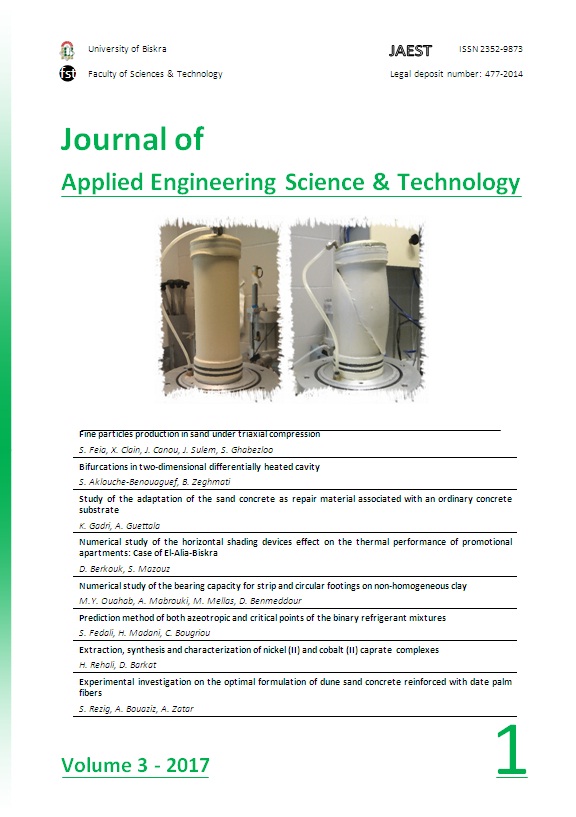
Experimental investigation on the optimal formulation of dune sand concrete reinforced with date palm fibers
 View 911/
 497
DOI:
https://doi.org/10.69717/jaest.v3.i1.47Keywords:
Sand concrete, Optimal Formulation, Mechanical strength, Mass loss, Date palm fibersAbstract
The main objective of this study is to propose an optimal formulation of sand concrete.The experimental approach consists in fixing the cement dosage at 350 kg / m3 and, in the firstphase, to investigate the optimum proportions of each constituent (limestone filler, silica fume,water and adjuvant). The second phase of this study was reserved for the effect of date palm fiberson the optimal formulation deduced from the experimental program of the first phase. The datepalm fiber mass rates studied are: 0.5%, 1%, 1.5% and 2%. The results obtained from the firstphase made it possible to fix the desired optimal composition equivalent to a unit volume of sandconcrete (1 m3 ). The cement dosage was maintained at 350 kg, dune sand, alluvial sand, finelimestone, silica fume, water and superplasticizer were optimized respectively as follows: 423.98kg; 980.34 kg; 165 kg; 35 kg; 210 kg and 2%.The results obtained from the second phase showdifferent tendencies in compression than in indirect traction. Indeed, a reduction in resistance wasrecorded in compression as a function of the increase in the rate of the reinforcement of datepalm fibers. This progressive decrease can reach 27% when the rate of reinforcement is equal to2%. On the other hand, a fluctuation in the results of traction in the range of 5 to 6 MPa wasrecorded. The maximum tensile strength was reached at a date palm fiber content of 1%. Theresults obtained from the mass loss measurements clearly showed that the increase in the fiberreinforcement rate induces a decrease in the mass loss estimated at 23.5 %.
Downloads
Downloads
Published
Issue
Section
License

This work is licensed under a Creative Commons Attribution-NonCommercial 4.0 International License.
Copyright and Licensing Terms
Journal of Applied Engineering Science and Technology (JAEST)
Effective September 2026, JAEST adopted the Creative Commons Attribution 4.0 International License (CC BY 4.0) for newly published articles.
Under this license, readers may share, distribute, reproduce, adapt, and reuse published articles, including for commercial purposes, provided that appropriate credit is given to the original authors, the license is linked, and any changes are indicated.
Authors retain copyright of their work and grant JAEST the right of first publication.
Current Publication License: CC BY 4.0
Note on previously published articles: Articles published before September 2026 remain subject to their originally applicable licensing and copyright terms unless a change has been authorized by the respective rights holders. The current CC BY 4.0 policy does not automatically relicense previously published content.
For complete information, consult the JAEST Open Access Statement .