Experimental and Simulation Study of Copper (II) Adsorption on Activated Carbon Using Date nuts
 View 259/
 50
0
50
0
DOI:
https://doi.org/10.69717/jaest.v6.i2.171Keywords:
Adsorption, Copper (II), Date nut activated carbon, Langmuir isotherm, MATLAB simulation (Hassouna Algorithm), Numerical optimizationAbstract
This study evaluates the efficiency of Cu2+ ion removal using powdered activated carbon derived from date nuts in aqueous solutions. The maximum adsorption capacity reached 98.34 mg/g (Langmuir model) with a removal efficiency of 83.0 % at optimal conditions (initial concentration = 3 g/L, adsorbent dosage = 4 g/L, pH = 7.0, temperature = 25°C). Near-equilibrium was approached after 90 minutes, as adsorption became very slow after 60 minutes with only 3.6 % increase between 60 and 90 minutes. Kinetic analysis indicates that the pseudo-second-order model best describes the adsorption behavior with a correlation coefficient of R2 = 0.999. The computational model (Hassouna Algorithm) achieved a strong correlation coefficient of R2 = 0.999 and a very low mean squared error of MSE = 3.94 × 10⁻⁴, demonstrating high predictive accuracy. The Langmuir isotherm (R2 = 0.9964) provided a better fit than the Freundlich model (R2 = 0.9140), indicating monolayer adsorption on a homogeneous surface. The pseudo-second-order kinetic model (R2 = 1.0) suggests that chemisorption is the rate-limiting step. Overall, the findings confirm that biomass-derived activated carbon combined with computational modeling offers an effective and sustainable approach for copper removal in waste water treatment.
Highlights
- Date-nut-derived activated carbon is an effective adsorbent for Cu2+.
- Adsorption is strongly affected by contact time and initial concentration.
- Langmuir isotherm and pseudo-second-order kinetic model best describe the process.
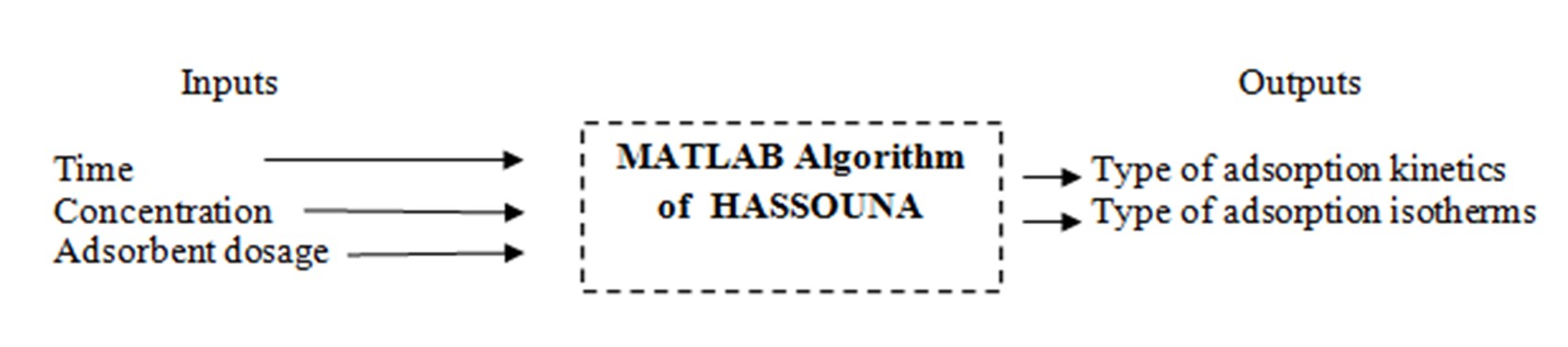
- MATLAB-based Hassouna Algorithm provides accurate adsorption simulation.
- Excellent agreement between experimental and modeled data (R2 ≈ 0.999).
Downloads
References
H.H. Al-Moameri, A.A. Ayash, S.Z.A. Al-Najjar, A.A. Lubguban, R.M. Malaluan, Simulation study of the liquid-solid multistage adsorption process, Sustainability 15 (2023) 3345. https://doi.org/10.3390/su15043345.
D. Gusain, V. Srivastava, Y.C. Sharma, Kinetic and thermodynamic studies on the removal of Cu(II) ions from aqueous solutions by adsorption on modified sand, J. Ind. Eng. Chem. 20 (2014) 841–847. https://doi.org/10.1016/j.jiec.2013.06.014.
M.Q. Jiang, X.Y. Jin, X.Q. Lu, Z.L. Chen, Adsorption of Pb(II), Cd(II), Ni(II), and Cu(II) onto natural kaolinite clay, Desalination 252 (2010) 33–39. https://doi.org/10.1016/j.desal.2009.11.005.
F. Bouhamed, Z. Elouear, J. Bouzid, Adsorptive removal of copper(II) from aqueous solutions on activated carbon prepared from Tunisian date stones: equilibrium, kinetics and thermodynamics, J. Taiwan Inst. Chem. Eng. 43 (2012) 741–749. https://doi.org/10.1016/j.jtice.2012.02.011.
A.M. Ghaedi, M. Ghaedi, A. Vafaei, N. Iravani, M. Keshavarz, M. Rad, I. Tyagi, S. Agarwal, V.K. Gupta, Adsorption of copper (II) using modified activated carbon prepared from Pomegranate wood: Optimization by bee algorithm and response surface methodology, Journal of Molecular Liquids 206 (2015) 195–206. https://doi.org/10.1016/j.molliq.2015.02.029.
H. Rehali, D. Elbar, L. Ghiaba, K. Bounafi, Elimination of nickel(II) in water with different activated carbons (date nut, peach nut, and apricot kernels), Dig. J. Nanomater. Biostruct. 16 (2021) 109–118. https://doi.org/10.15251/DJNB.2021.161.109.
A.B. Wilson, E.W. Jenkins, J. Wang, S.M. Husson, Numerical simulation of chemical separations using multimodal adsorption isotherms, Results Appl. Math. 7 (2020) 100122. https://doi.org/10.1016/j.rinam.2020.100122.
T. Bohli, I. Villaescusa, A. Ouederni, Comparative adsorption of Pb(II), Cd(II), Ni(II) and Cu(II) on olive-stone activated carbon, J. Chem. Eng. Process Technol. 4 (2013) 1–7. http://dx.doi.org/10.4172/2157-7048.1000158.
Published
Issue
Section
License
Copyright (c) 2026 Journal of Applied Engineering Science and Technology

This work is licensed under a Creative Commons Attribution 4.0 International License.
The Journal of Applied Engineering Science and Technology (JAEST) provides immediate open access to its content on the principle that making research freely available to the public supports a greater global exchange of knowledge.
All articles published in JAEST are licensed under the Creative Commons Attribution 4.0 International License (CC BY 4.0). This license permits users to share, copy, redistribute, adapt, and reproduce the published material in any medium or format, including for commercial purposes, provided that appropriate credit is given to the original author(s) and source, a link to the license is provided, and any changes made are indicated.
Authors retain the copyright of their published work and grant JAEST the right of first publication. Copyright is not transferred to the journal or publisher.
License: Creative Commons Attribution 4.0 International (CC BY 4.0)
License URL: Creative Commons CC BY 4.0