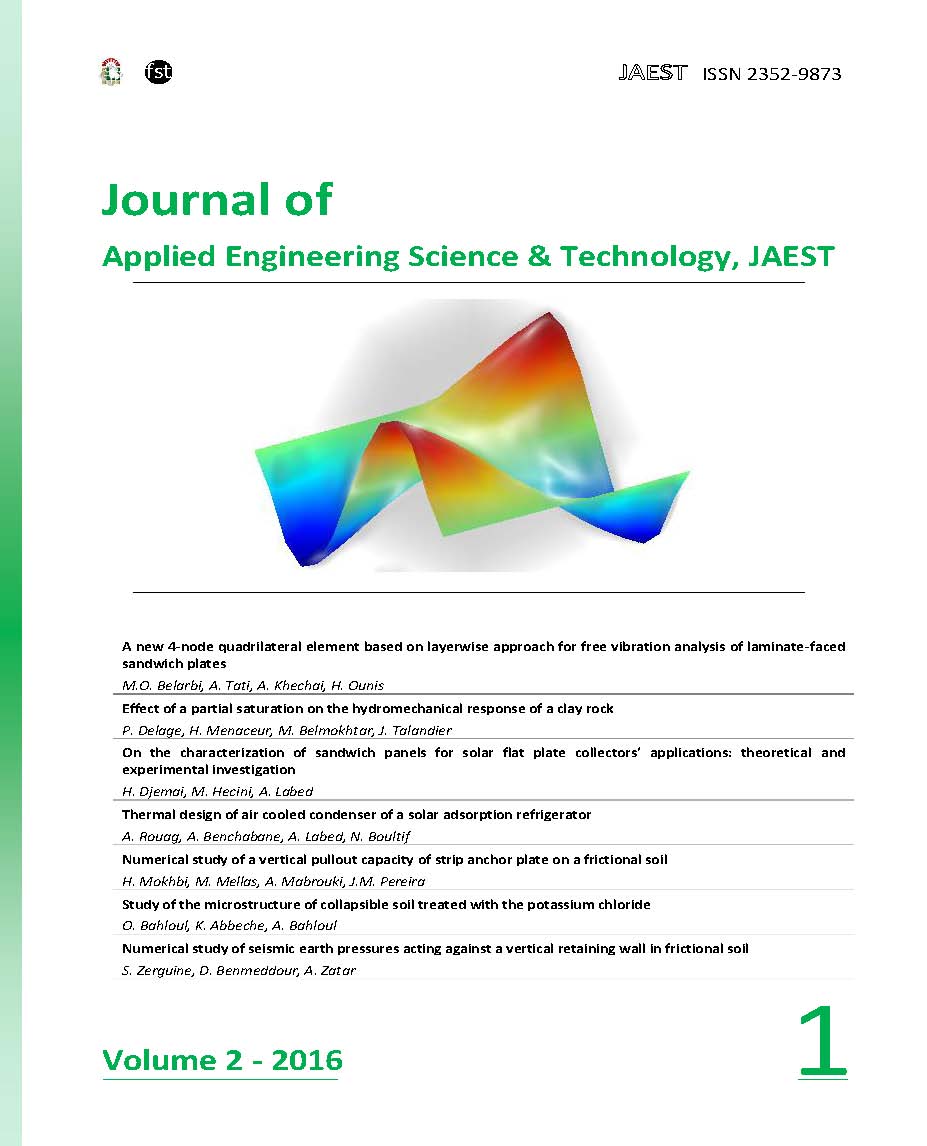
Numerical study of a vertical pullout capacity of strip anchor plate on a frictional soil
 View 872/
 427
DOI:
https://doi.org/10.69717/jaest.v2.i1.29Keywords:
Plate anchor, Pullout capacity, Finite element, Frictional soilAbstract
This paper presents a numerical study of the ultimate pullout capacity of an isolated stripplate anchor, using the finite element method by Plaxis 2D software. The plate anchor is assumedrigid horizontally installed in a frictional soil and subjected to a centered vertical load. The soilbehavior is governed by an elastic‐perfectly plastic law, and Mohr‐Coulomb criterion was adopted.The ultimate pullout capacity is expressed in terms of pullout factor Nγ for different values of thedepth H and the internal friction angle of soil φ'. The numerical results obtained allow us topropose a simple relationship to calculate the pullout factor of a strip plate anchor embeddedhorizontally in frictional soil. The numerical results of this study are finally compared to thoseavailable in the literature.
Downloads
Downloads
Published
Issue
Section
License

This work is licensed under a Creative Commons Attribution-NonCommercial 4.0 International License.
Copyright and Licensing Terms
Journal of Applied Engineering Science and Technology (JAEST)
Effective September 2026, JAEST adopted the Creative Commons Attribution 4.0 International License (CC BY 4.0) for newly published articles.
Under this license, readers may share, distribute, reproduce, adapt, and reuse published articles, including for commercial purposes, provided that appropriate credit is given to the original authors, the license is linked, and any changes are indicated.
Authors retain copyright of their work and grant JAEST the right of first publication.
Current Publication License: CC BY 4.0
Note on previously published articles: Articles published before September 2026 remain subject to their originally applicable licensing and copyright terms unless a change has been authorized by the respective rights holders. The current CC BY 4.0 policy does not automatically relicense previously published content.
For complete information, consult the JAEST Open Access Statement .