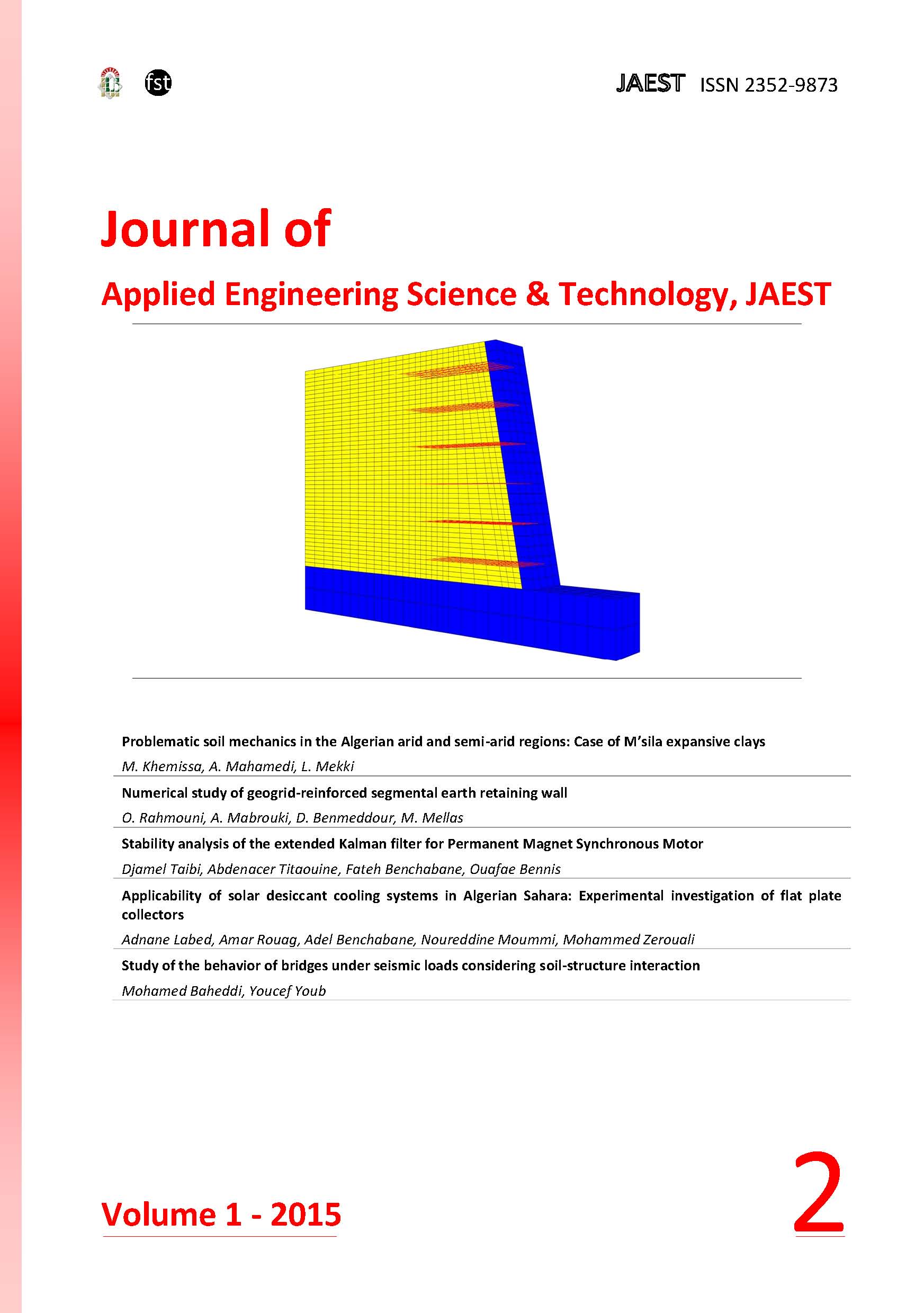
Applicability of solar desiccant cooling systems in Algerian Sahara: Experimental investigation of flat plate collectors
 View 770/
 604
DOI:
https://doi.org/10.69717/jaest.v1.i2.27Keywords:
Air conditioning, Desiccant cooling, Sorption, Solar collectors, Saharan climateAbstract
The increasing interest in the development of solar cooling technologies to their various economic and impressive environmental benefits, conducted us to study the feasibility of solar desiccant cooling systems in Algerian Sahara, particularly in the region of Biskra. Thus, we present in this paper, the results of an experimental investigation of solar flat plate collectors (FPCs) to test and estimate their heat regeneration capacity for solid desiccant cooling applications. The applicability of both Pennington and Dunkle cycles taking into account the effects of some parameters such as outdoor humidity and temperature and hot air temperature required to regenerate the desiccant wheel have been studied. From the psychrometric analysis, it was found that the Dunkle cycle is suitable in warm and semiarid climate. In addition, this study has allowed us to show that the temperature achieved by the flat plate solar air heaters in a large band of air flow rate can satisfy the energy needs for the dehumidification in desiccant cooling systems. Hot water produced by the solar water heaters and the stored one are in the operating temperature gap of the system (50-80 °C).
Downloads
Downloads
Published
Issue
Section
License

This work is licensed under a Creative Commons Attribution-NonCommercial 4.0 International License.
Copyright and Licensing Terms
Journal of Applied Engineering Science and Technology (JAEST)
Effective September 2026, JAEST adopted the Creative Commons Attribution 4.0 International License (CC BY 4.0) for newly published articles.
Under this license, readers may share, distribute, reproduce, adapt, and reuse published articles, including for commercial purposes, provided that appropriate credit is given to the original authors, the license is linked, and any changes are indicated.
Authors retain copyright of their work and grant JAEST the right of first publication.
Current Publication License: CC BY 4.0
Note on previously published articles: Articles published before September 2026 remain subject to their originally applicable licensing and copyright terms unless a change has been authorized by the respective rights holders. The current CC BY 4.0 policy does not automatically relicense previously published content.
For complete information, consult the JAEST Open Access Statement .