Solvent Extraction of Hydrocarbons from Petroleum Sludge: Experimental Optimisation Using Response Surface Methodology and Artificial Neural Networks
 View 269/
 47
0
47
0
DOI:
https://doi.org/10.69717/jaest.v6.i2.177Keywords:
Petroleum sludge, Energy recovery, Sustainable management, Solvent extraction, Optimisation, Artificial neural networkAbstract
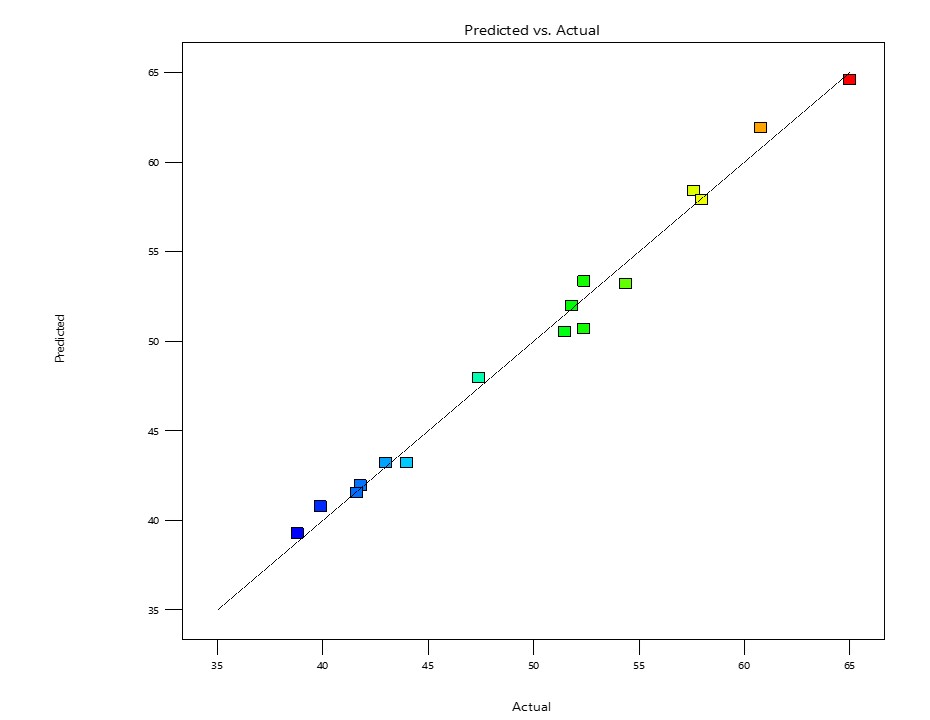
The sustainable management of petroleum sludge from refinery storage tanks has become a growing environmental concern. These semi-solid wastes, rich in hydrocarbons, present significant challenges due to their toxicity, persistence in natural ecosystems, and the absence of dedicated treatment pathways. Nevertheless, their high content of heavy hydrocarbons also offers considerable potential for energy recovery, which remains largely underexploited in the national context. This study aims to assess the efficiency of solvent extraction for hydrocarbon recovery from petroleum sludge, with a particular focus on n-hexane as the extracting solvent. Owing to its non-polar nature and strong affinity for light to intermediate petroleum fractions, n-hexane enables selective extraction at relatively low energy cost. A rigorous experimental methodology was applied, combining Design of Experiments (DOE), Response Surface Methodology (RSM), and Artificial Neural Network (ANN) to model the extraction yield as a function of temperature, agitation time, and solvent volume. The models were then coupled with a genetic algorithm to determine the optimal operating conditions. The ANN model outperformed RSM in terms of prediction accuracy (R2 = 0.9917 vs. 0.9891, RMSE = 0.71 % vs. 0.81 %). The genetic algorithm coupled with ANN predicted a maximum recovery yield of 65.8 % at a sludge-to-solvent mass ratio of 0.166, in good agreement with the experimental maximum of 65.0 % (ratio 0.172) and with literature data. These results confirm the potential of solvent extraction as a promising pathway for the valorisation of petroleum sludge in Algeria and demonstrate the effectiveness of ANN-based modelling for process optimisation.
Highlights
- First study in Algeria combining solvent extraction with RSM and ANN for petroleum sludge valorisation.
- ANN outperformed RSM in predicting extraction yield (R2 = 0.9917; RMSE = 0.71%).
- ANN-GA predicted 65.8% recovery, matching the experimental yield of 65.0%.
- Solvent extraction recovers hydrocarbons while reducing the volume and toxicity of petroleum sludge.
Downloads
References
N.P. Cheremisinoff, P. Rosenfeld, Handbook of Pollution Prevention and Cleaner Production – Best Practices in the Petroleum Industry, William Andrew Publishing, 2010.
J.F. Lodungi, D.B. Alfred, K.A.F.M. Khirulthzam, F.F.R.B. Adnan, S. Tellichandran, A review in oil exploration and production waste discharges according to legislative and waste management practices perspective in Malaysia, International Journal of Waste Resources 7 (2017) 260. https://doi.org/10.4172/2252-5211.1000260.
G. Hu, Development of Novel Oil Recovery Methods for Petroleum Refinery Oily Sludge Treatment, University of Northern British Columbia, 2016. https://doi.org/10.24124/2016/bpgub1119.
J.C. Reis, Environmental Control in Petroleum Engineering, Gulf Professional Publishing, 1996. https://doi.org/10.1016/B978-0-88415-273-6.X5000-8.
G. Hu, J. Li, G. Zeng, Recent development in the treatment of oily sludge from petroleum industry: A review, Journal of Hazardous Materials 261 (2013) 470–490. https://doi.org/10.1016/j.jhazmat.2013.07.069.
F. Souas, Rheological behavior of oil sludge from Algerian refinery storage tanks, Petroleum Research 7 (2022) 536–544. https://doi.org/10.1016/j.ptlrs.2022.01.002.
A.Y. El Naggar, E.A. Saad, A.T. Kandil, H.O. Elmoher, Petroleum cuts as solvent extractor for oil recovery from petroleum sludge, Journal of Petroleum Technology and Alternative Fuels 1 (2010) 10–19. https://doi.org/10.5897/JPTAF.9000021.
F. Nezhdbahadori, M. Abdoli, M. Baghdadi, F. Ghazban, A comparative study on the efficiency of polar and non-polar solvents in oil sludge recovery using solvent extraction, Environmental Monitoring and Assessment 190 (2018) 389. https://doi.org/10.1007/s10661-018-6748-6.
M. Hassanzadeh, L. Tayebi, H. Dezfouli, Investigation of factors affecting viscosity reduction of sludge from Iranian crude oil storage tanks, Petroleum Science 15 (2018) 634–643. https://doi.org/10.1007/s12182-018-0247-9.
L.J. da Silva, F.C. Alves, F.P. de França, A review of the technological solutions for the treatment of oily sludges from petroleum refineries, Waste Management & Research 30 (2012) 1016–1030. https://doi.org/10.1177/0734242X12448517.
G. Hu, J. Li, H. Hou, A combination of solvent extraction and freeze–thaw for oil recovery from petroleum refinery wastewater treatment pond sludge, Journal of Hazardous Materials 313 (2016) 289–296. https://doi.org/10.1016/j.jhazmat.2016.03.073.
J. Liang, L. Zhao, N. Du, H. Li, W. Hou, Solid effect in solvent extraction treatment of pre-treated oily sludge, Separation and Purification Technology 130 (2014) 28–33. https://doi.org/10.1016/j.seppur.2014.03.027.
S.M. Al-Zahrani, M.D. Putra, Used lubricating oil regeneration by various solvent extraction techniques, Journal of Industrial and Engineering Chemistry 19 (2013) 536–539. https://doi.org/10.1016/j.jiec.2012.09.007.
E.A. Taiwo, J.A. Otolorin, Oil recovery from petroleum sludge by solvent extraction, Petroleum Science and Technology 27 (2009) 836–844. https://doi.org/10.1080/10916460802455582.
R. Ahmed, C.M. Sinnathambi, U. Eldmerdash, N-Hexane, Methyl Ethyl Ketone and Chloroform Solvents for Oil Recovery from Refinery Waste, Applied Mechanics and Materials 699 (2015) 666–671. https://doi.org/10.4028/www.scientific.net/AMM.699.666.
K. Hornik, M. Stinchcombe, H. White, Multilayer feedforward networks are universal approximators, Neural Networks 2 (1989) 359–366. https://doi.org/10.1016/0893-6080(89)90020-8.
K. Rewatkar, D.Z. Shende, K.L. Wasewar, Reactive separation of gallic acid: Experimentation and optimization using response surface methodology and artificial neural network, Chemical and Biochemical Engineering Quarterly 31 (2017) 33–42.
A.A. Mansur, M. Pannirselvam, K.A. Al-Hothaly, E.M. Adetutu, A.S. Ball, Recovery and characterization of oil from waste crude oil tank bottom sludge from Azzawiya Oil Refinery in Libya, Journal of Advanced Chemical Engineering 5 (2015) 118. https://doi.org/10.4172/2090-4568.1000118.
Y. Yücel, Ö. Otuzbir, E. Yücel, Surface roughness prediction in SILAR coating process of ZnO thin films: Mathematical modelling and validation, Materials Today Communications 34 (2023) 105101. https://doi.org/10.1016/j.mtcomm.2022.105101.
N. Barnier, P. Brisset, Optimisation par algorithme génétique sous contraintes, Technique et Science Informatiques 18 (1999) 1–24.
Published
Issue
Section
License
Copyright (c) 2026 Journal of Applied Engineering Science and Technology

This work is licensed under a Creative Commons Attribution 4.0 International License.
The Journal of Applied Engineering Science and Technology (JAEST) provides immediate open access to its content on the principle that making research freely available to the public supports a greater global exchange of knowledge.
All articles published in JAEST are licensed under the Creative Commons Attribution 4.0 International License (CC BY 4.0). This license permits users to share, copy, redistribute, adapt, and reproduce the published material in any medium or format, including for commercial purposes, provided that appropriate credit is given to the original author(s) and source, a link to the license is provided, and any changes made are indicated.
Authors retain the copyright of their published work and grant JAEST the right of first publication. Copyright is not transferred to the journal or publisher.
License: Creative Commons Attribution 4.0 International (CC BY 4.0)
License URL: Creative Commons CC BY 4.0