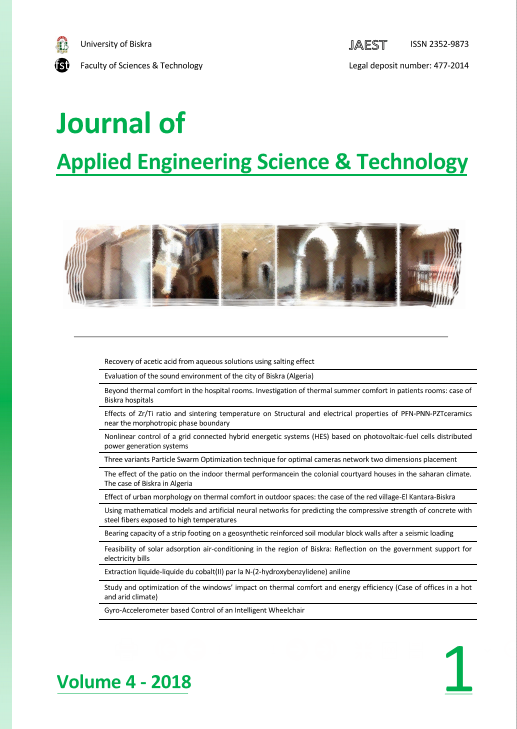
Study and optimization of the windows’ impact on thermal comfort and energy efficiency (Case of offices in a hot and arid climate)
 View 834/
 428
DOI:
https://doi.org/10.69717/jaest.v4.i1.82Keywords:
Windows of the facade, Thermal comfort, Energetic efficiency, Office building, Simulation, Hot and arid climateAbstract
Controlling the thermal environment and reducing the energy consumption of buildings across the façade are a difficult challenge for architects, especially in a desert climate. The windows in particular play an important role in the tandem of the thermal operation of the building and the comfort of the users. The objective of this article is to study and optimize the impact of windows, their material and proportional characteristics on the thermal comfort and energy efficiency of office buildings in a hot and arid climate. The investigation is based on an empirical approach (measurements taken in situ on real cases) as well as on a numerical simulation study with the TRNSYS program. Several parameters have been studied such as surface temperature, ambient temperature and energy consumption. The results showed that facade windows are a determining factor in the thermal exchanges between the building and its environment and that the key parameters that condition these exchanges are the windows ratio (glazed area) and the type of glazing. The judicious choice of the windows ratio combined with an appropriate choice of the type and composition of the glazing improves the thermal comfort of the users and ensures the energy performance of the building.
Downloads
Downloads
Published
Issue
Section
License
Copyright and Licensing Terms
Journal of Applied Engineering Science and Technology (JAEST)
Effective September 2026, JAEST adopted the Creative Commons Attribution 4.0 International License (CC BY 4.0) for newly published articles.
Under this license, readers may share, distribute, reproduce, adapt, and reuse published articles, including for commercial purposes, provided that appropriate credit is given to the original authors, the license is linked, and any changes are indicated.
Authors retain copyright of their work and grant JAEST the right of first publication.
Current Publication License: CC BY 4.0
Note on previously published articles: Articles published before September 2026 remain subject to their originally applicable licensing and copyright terms unless a change has been authorized by the respective rights holders. The current CC BY 4.0 policy does not automatically relicense previously published content.
For complete information, consult the JAEST Open Access Statement .