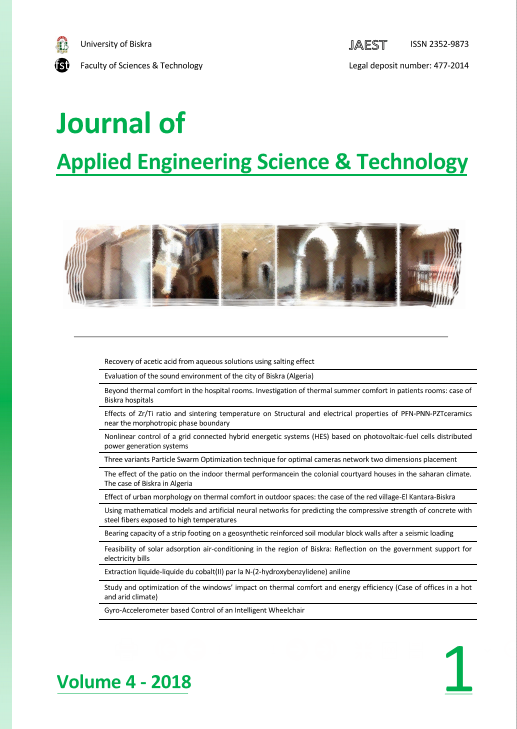
Recovery of acetic acid from aqueous solutions using salting effect
 View 937/
 687
DOI:
https://doi.org/10.69717/jaest.v4.i1.64Keywords:
Acetic acid recovery, Liquid-liquid equilibrium, Salting effect, Sodium chloride, Sodium sulfateAbstract
The application of salting effect to isolate an organic acid, particularly Acetic acid, from aqueous solution is reported. In fact the presence of a salt can influence the solubility of a compound by either increasing it or decreasing it, leading to Salting-in and Salting-out, respectively. The addition of a salt in an aqueous solution introduces ionic forces which affect liquid-liquid equilibrium and which influence directly the distribution coefficient of the solute. The effect of NaCl and Na2SO4 on the liquid-liquid equilibrium data of the ternary system (Water+ Acetic Acid+ Dichloromethane) at a temperature of 293.15 K and an atmospheric pressure is studied experimentally in this work. The mass fractions of salt in the total mixture are 5%, 10% and 20%. It is noted that the equilibrium between phases is modified preferably to the extracted phase and the salting-out in the case of sodium sulfate is more significant than the effect of chloride.
Downloads
Downloads
Published
Issue
Section
License

This work is licensed under a Creative Commons Attribution-NonCommercial 4.0 International License.
Copyright and Licensing Terms
Journal of Applied Engineering Science and Technology (JAEST)
Effective September 2026, JAEST adopted the Creative Commons Attribution 4.0 International License (CC BY 4.0) for newly published articles.
Under this license, readers may share, distribute, reproduce, adapt, and reuse published articles, including for commercial purposes, provided that appropriate credit is given to the original authors, the license is linked, and any changes are indicated.
Authors retain copyright of their work and grant JAEST the right of first publication.
Current Publication License: CC BY 4.0
Note on previously published articles: Articles published before September 2026 remain subject to their originally applicable licensing and copyright terms unless a change has been authorized by the respective rights holders. The current CC BY 4.0 policy does not automatically relicense previously published content.
For complete information, consult the JAEST Open Access Statement .