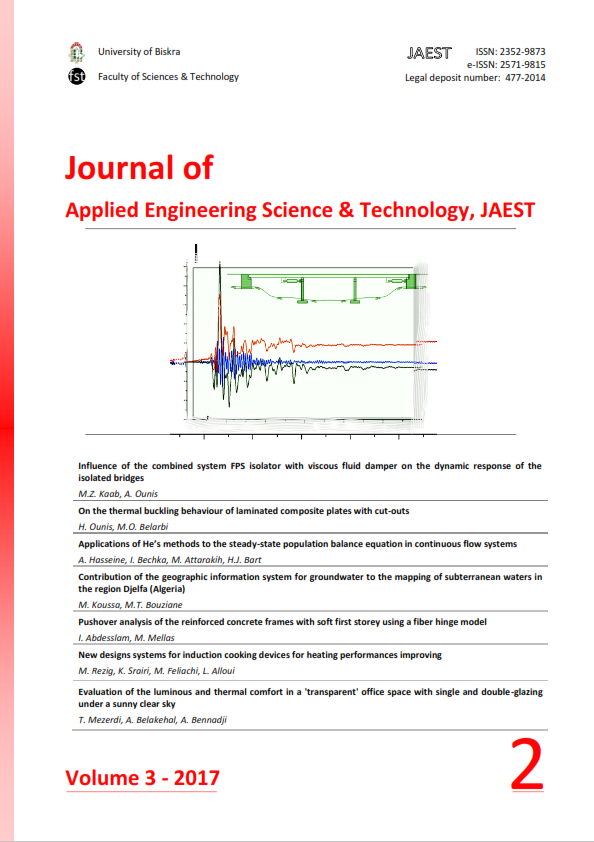
Influence of the combined system FPS isolator with viscous fluid damper on the dynamic response of the isolated bridges
 View 716/
 389
DOI:
https://doi.org/10.69717/jaest.v3.i2.61Keywords:
Seismic isolation, Bridge, FPS isolation system, Viscous fluid damper, Seismic responseAbstract
To illustrate the effect of the combined system FPS isolator (Fiction Pendulum System) with viscous fluid damper on the seismic response of the isolated bridges, a comparative study was realised on a bridge in three different situations. In first situation, we consider the bridge without seismic isolation, while in the second and the third situation, the bridge is successively equipped with a system of FPS isolator then with a combined system FPS isolator and viscous fluid damper. The analysis was done using the digital program of dynamic analysis of the structures SAP2000 and this study consists in comparing the responses of the bridge in terms of baseshear, displacement, acceleration and absorbed energy. The results show that the incorporation of a damping device with viscous fluid damper to the isolator allows to dissipate the maximum of energy, to control the deformations which are located at the level of the isolator and to realize a satisfying compromise between the reduction of the seismic forces and the increase of the deformations in the seismic isolation.
Downloads
Downloads
Published
Issue
Section
License

This work is licensed under a Creative Commons Attribution-NonCommercial 4.0 International License.
Copyright and Licensing Terms
Journal of Applied Engineering Science and Technology (JAEST)
Effective September 2026, JAEST adopted the Creative Commons Attribution 4.0 International License (CC BY 4.0) for newly published articles.
Under this license, readers may share, distribute, reproduce, adapt, and reuse published articles, including for commercial purposes, provided that appropriate credit is given to the original authors, the license is linked, and any changes are indicated.
Authors retain copyright of their work and grant JAEST the right of first publication.
Current Publication License: CC BY 4.0
Note on previously published articles: Articles published before September 2026 remain subject to their originally applicable licensing and copyright terms unless a change has been authorized by the respective rights holders. The current CC BY 4.0 policy does not automatically relicense previously published content.
For complete information, consult the JAEST Open Access Statement .