Performance Analysis and Optimization of BaHfS₃-Based Solar Cells Using SCAPS-1D Simulation Software
 View 316/
 134
0
134
0
DOI:
https://doi.org/10.69717/jaest.v6.i2.148Keywords:
BaHfS3, Solar cells, SCAPS-1D, Photovoltaic, AbsorberAbstract
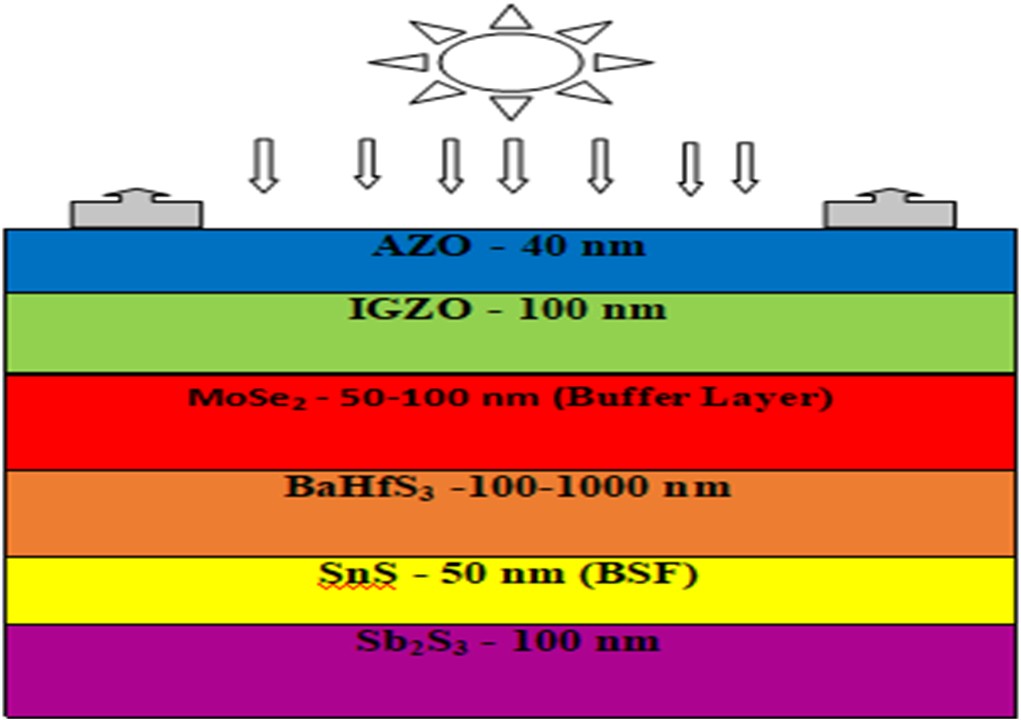
Although early theoretical studies and experimental studies indicate the potential of Barium Hafnium Sulfide (BaHfS3) as a photovoltaic absorber material, comprehensive device-level research under practical working conditions remains minimal. Chalcogenide BaHfS3 is a lead-free absorber layer material that has garnered attention because of its promising optical absorption and potential stability for solar energy technology. In this research, BaHfS3-based solar cell designs are investigated through Solar Cell Capacitance Simulator (SCAPS-1D) software numerical modeling. Optimization aspects of the device, such as absorber thickness, bandgap energy, defect density, operating temperature, parasitic resistances, buffer layer thickness, and charge transport material are considered. The base model (AZO/IGZO/BaHfS3/Sb2S3) recorded an η of 8.78 %, FF of 52.67 %, Jsc of 19.90 mA/cm2, and Voc of 0.837 V. The absorber thickness ranging from 300-400 nm presents a fair compromise between light absorption and carrier transport, Voc starts at 0.90 V and decreases to 0.84 V, Jsc rises from 23 mA/cm2 to 27 mA/cm2, FF declines from 75 % down to 30 % and recorded and efficiency of 16.1 %, while bandgap energy tuning showed a maximum η of 16.2 % at 1.5 eV. Lowering absorber defect density to Nt = 1 × 1010 cm-3 enhances device performance, where Voc = 0.86 V, Jsc = 27 mA/cm², FF = 83 % and η increased to 19 %. Thermal effects were modest, with η of 18.8 % at the temperature between 340 and 350 K. Under optimized parasitic resistances, series resistance (Rs) recorded η of 18.7 % as Rs varies from 1–10 Ω·cm2, whereas shunt related losses severely degraded η to 1.59 %. Increasing MoSe2 layer thickness improved the η from 18.7 % to 25.39 % at the thickness of 1000 nm. In the transport layers studies Ti2O3 is identify as the most effective ETM and CuS as the best HTM. The optimized TiO2/BaHfS3/CuS device achieved an efficiency of 19 % due to favorable Type-II band alignment and efficient charge separation. BaHfS3 can be a promising absorber material for the next-generation photovoltaic applications, and these findings confirm its potential.
Highlights
- SCAPS-1D was used to model BaHfS3-based solar cell.
- Influence of absorber thickness and defect density on device performance.
- Optimization of transport layers for improved efficiency.
- Temperature-dependent photovoltaic behavior systemically analyzed.
- Buffer layer thickness optimization.
Downloads
References
S. Pawar, Harnessing the Power of Renewable Energy: A Study of Sustainable Sources and Technologies, Journal of Research in Applied Science and Biotechnology 3 (2024) 163–169. https://doi.org/10.55544/jrasb.3.4.19.
A. Balal, Y. Pakzad Jafarabadi, A. Demir, M. Igene, M. Giesselmann, S. Bayne, Forecasting Solar Power Generation Utilizing Machine Learning Models in Lubbock, Emerging Science Journal 7 (2023) 1052–1062. https://doi.org/10.28991/ESJ-2023-07-04-02.
Md. T. Sarker, M. H. S. M. Haram, S. J. Shern, G. Ramasamy, F. Al Farid, Readiness of Malaysian PV System to Utilize Energy Storage System with Second-Life Electric Vehicle Batteries, Energies 17 (2024) 3953. https://doi.org/10.3390/en17163953.
S. Kumar, K. Rathore, Renewable Energy for Sustainable Development Goal of Clean and Affordable Energy, International Journal of Materials Manufacturing and Sustainable Technologies 2 (2023) 1–15. https://doi.org/10.56896/IJMMST.2023.2.1.001.
M. F. Rabbi, J. Popp, D. Máté, S. Kovács, Energy Security and Energy Transition to Achieve Carbon Neutrality, Energies 15 (2022) 8126. https://doi.org/10.3390/en15218126.
M. K. Hossain et al., Photovoltaic Performance Investigation of Cs3Bi2I9-Based Perovskite Solar Cells with Various Charge Transport Channels Using DFT and SCAPS-1D Frameworks, Energy & Fuels 37 (2023) 7380–7400. https://doi.org/10.1021/acs.energyfuels.3c00540.
V. Kumar, S. Kumari, P. Kumar, M. Kar, L. Kumar, Structural Analysis by Rietveld Method and Its Correlation with Optical Properties of Nanocrystalline Zinc Oxide, Advanced Materials Letters 6 (2015) 139–147. https://doi.org/10.5185/amlett.2015.5632.
A. Lafond, C. Guillot-Deudon, J. Vidal, M. Paris, C. La, S. Jobic, Substitution of Li for Cu in Cu2ZnSnS4: Toward Wide Band Gap Absorbers with Low Cation Disorder for Thin Film Solar Cells, Inorganic Chemistry 56 (2017) 2712–2721. https://doi.org/10.1021/acs.inorgchem.6b02865.
M. Krause, S.-C. Yang, S. Moser, S. Nishiwaki, A. N. Tiwari, R. Carron, Silver-Alloyed Low-Bandgap CuInSe2 Solar Cells for Tandem Applications, Solar RRL 7 (2023) 2201122. https://doi.org/10.1002/solr.202201122.
D. Srinivasan, A.-D. Rasu Chettiar, L. Marasamy, Engineering BaHfS3 with Zr Alloying to Improve Solar Cell Performance: Insights from SCAPS-1D Simulations, Materials Science and Engineering: B 315 (2025) 118126. https://doi.org/10.1016/j.mseb.2025.118126.
B. K. Bareth, M. N. Tripathi, High Photovoltaic Performance of an Emerging Lead-Free Chalcogenide Perovskite BaHfS3 under High Pressure, Solar Energy Materials and Solar Cells 282 (2025) 113445. https://doi.org/10.1016/j.solmat.2025.113445.
N. El Hidaoui, F. Goumrhar, L. B. Drissi, O. Boudouch, R. A. Laamara, Evaluation of Chalcogenide Perovskites BaHfS3 for Charge Transport in Energy Conversion Applications: Solar Cells, Photocatalytic Water Splitting and Thermoelectric, Computational Condensed Matter 46 (2026) e01202. https://doi.org/10.1016/j.cocom.2025.e01202.
M. K. A. Mohammed, Optimizing Non-Toxic (CH3NH3)3Bi2I9 Perovskite Solar Cells by SCAPS-1D, Physica Scripta 99 (2024) 125980. https://doi.org/10.1088/1402-4896/ad9221.
E. M. Grumstrup, M. M. Gabriel, C. W. Pinion, J. K. Parker, J. F. Cahoon, J. M. Papanikolas, Reversible Strain-Induced Electron–Hole Recombination in Silicon Nanowires Observed with Femtosecond Pump–Probe Microscopy, Nano Letters 14 (2014) 6287–6292. https://doi.org/10.1021/nl5026166.
X. Zheng, E. Colegrove, J. N. Duenow, J. Moseley, W. K. Metzger, Roles of Bandgrading, Lifetime, Band Alignment, and Carrier Concentration in High-Efficiency CdSeTe Solar Cells, Journal of Applied Physics 128 (2020) 053102. https://doi.org/10.1063/5.0013726.
N. Shrivastav et al., Two-Terminal Tandem Solar Cell with Sb2S3/Sb2Se3 Absorber Pair: Achieving 14% Power Conversion Efficiency, Physica Scripta 98 (2023) 115110. https://doi.org/10.1088/1402-4896/ad000e.
A. Hosen, S. R. A. Ahmed, Performance Analysis of SnS Solar Cell with a Hole Transport Layer Based on Experimentally Extracted Device Parameters, Journal of Alloys and Compounds 909 (2022) 164823. https://doi.org/10.1016/j.jallcom.2022.164823.
T.A. Chowdhury, R.B. Arif, H. Israq, N. Sharmili, and R.S. Shuvo, SCAPS Numerical Design of MoSe2 Solar Cell for Different Buffer Layers, Chalcogenide Letters 21 (2024) 175–187. https://doi.org/10.15251/CL.2024.212.175.
K. Deepthi Jayan, V. Sebastian, Modelling and Comparative Performance Analysis of Tin-Based Mixed Halide Perovskite Solar Cells with IGZO and CuO as Charge Transport Layers, International Journal of Energy Research 45 (2021) 16618–16632. https://doi.org/10.1002/er.6909.
T. A. Chowdhury, SCAPS Modeling and Performance Analysis of AZO/SnS2/CZTS Solar Cells, Optics Continuum 3 (2024) 1341. https://doi.org/10.1364/OPTCON.527415.
J. Guo et al., Effect of Selenium and Chlorine Co-Passivation in Polycrystalline CdSeTe Devices, Applied Physics Letters 115 (2019) 153901. https://doi.org/10.1063/1.5123169.
M. N. Harif et al., Effect of Cu2Te Back Surface Interfacial Layer on Cadmium Telluride Thin Film Solar Cell Performance from Numerical Analysis, Crystals 13 (2023) 848. https://doi.org/10.3390/cryst13050848.
M. D. Hredoy Hossain, N. SURAYA, M. D. Eakub Ali, M. D. Momin Biswas, Analytical Analysis of High-Efficient Thin Film BaSi2/In2S3 Solar Cell with SCAPS 1-D Simulation, EMERG – Energy Environment Efficiency Resources Global 11 (2025) 29–40. https://doi.org/10.37410//EMERG.2025.1.03.
J. Chantana, T. Kato, H. Sugimoto, T. Minemoto, Investigation of Correlation Between Open-Circuit Voltage Deficit and Carrier Recombination Rates in Cu(In,Ga)(S,Se)2-Based Thin-Film Solar Cells, Applied Physics Letters 112 (2018) 151601. https://doi.org/10.1063/1.5023828.
C. Lin et al., The Investigation of the Influence of a Cu2O Buffer Layer on Hole Transport Layers in MAPbI3-Based Perovskite Solar Cells, Materials 15 (2022) 8142. https://doi.org/10.3390/ma15228142.
S. Z. Haider, H. Anwar, M. Wang, Theoretical Device Engineering for High-Performance Perovskite Solar Cells Using CuSCN as Hole Transport Material to Boost the Efficiency Above 25%, Physica Status Solidi A 216 (2019) 1900102. https://doi.org/10.1002/pssa.201900102.
S. Ghosh, S. Yasmin, J. Ferdous, B. B. Saha, Numerical Analysis of a CZTS Solar Cell with MoS2 as a Buffer Layer and Graphene as a Transparent Conducting Oxide Layer for Enhanced Cell Performance, Micromachines 13 (2022) 1249. https://doi.org/10.3390/mi13081249.
A. Zeinidenov, T. Mukametkali, B. Ilyassov, A. Aimukhanov, D. Valiev, The Effect of MoO3 Interlayer on Electro-Physical Characteristics of the Perovskite Solar Cells, Synthetic Metals 281 (2021) 116903. https://doi.org/10.1016/j.synthmet.2021.116903.
I. Jeong et al., Solution-Processed Ultrathin TiO2 Compact Layer Hybridized with Mesoporous TiO2 for High-Performance Perovskite Solar Cells, ACS Applied Materials & Interfaces 9 (2017) 36865–36874. https://doi.org/10.1021/acsami.7b11901.
I. Qasim et al., Numerical Optimization of (FTO/ZnO/CdS/CH3NH3SnI3/GaAs/Au) Perovskite Solar Cell Using Solar Capacitance Simulator with Efficiency Above 23% Predicted, Optical and Quantum Electronics 53 (2021) 713. https://doi.org/10.1007/s11082-021-03361-5.
Md. N. H. Riyad, A. Sunny, Most. M. Khatun, S. Rahman, S. R. A. Ahmed, Performance Evaluation of WS2 as Buffer and Sb2S3 as Hole Transport Layer in CZTS Solar Cell by Numerical Simulation, Engineering Reports 5 (2023) e12600. https://doi.org/10.1002/eng2.12600.
M. Méndez, E. Palomares, Alq3 (tris(8-hydroxyquinolinato)aluminium) as a Selective n-Type Contact for FAMAPIBr Perovskite Solar Cells with Efficient Energy Transfer to Increase the Solar Cell Photocurrent, RSC Advances 7 (2017) 35525–35527. https://doi.org/10.1039/C7RA06645G.
A. Laidouci, Mamta, V. N. Singh, P. K. Dakua, D. K. Panda, Performance Evaluation of ZnSnN2 Solar Cells with Si Back Surface Field Using SCAPS-1D: A Theoretical Study, Heliyon 9 (2023) e20601. https://doi.org/10.1016/j.heliyon.2023.e20601.
K. Deepthi Jayan, V. Sebastian, Comprehensive Device Modelling and Performance Analysis of MASnI3-Based Perovskite Solar Cells with Diverse ETM, HTM and Back Metal Contacts, Solar Energy 217 (2021) 40–48. https://doi.org/10.1016/j.solener.2021.01.058.
A. Srivastava, B. P. Pandey, Performance Analysis of CZTS Solar Cell with ZnS+ZnMgO as a Buffer Layer Using SCAPS-1D, Proceedings of the 2023 International Conference on Computer, Electronics & Electrical Engineering & Their Applications (IC2E3), IEEE, Srinagar Garhwal, India (2023) 1–6. https://doi.org/10.1109/IC2E357697.2023.10262440.
Y. Chen et al., Multilayer Cascade Charge Transport Layer for High-Performance Inverted Mesoscopic All-Inorganic and Hybrid Wide-Bandgap Perovskite Solar Cells, Solar RRL 4 (2020) 2000344. https://doi.org/10.1002/solr.202000344.
A. Crovetto et al., Interface Band Gap Narrowing Behind Open-Circuit Voltage Losses in Cu2ZnSnS4 Solar Cells, Applied Physics Letters 110 (2017) 083903. https://doi.org/10.1063/1.4976830.
A. Fakharuddin et al., Robust Inorganic Hole Transport Materials for Organic and Perovskite Solar Cells: Insights into Materials Electronic Properties and Device Performance, Solar RRL 5 (2021) 2000555. https://doi.org/10.1002/solr.202000555.
G. M. Mustafa, B. Younas, S. Saba, Z. M. Elqahtani, N. Alwadai, S. Aftab, Numerical Simulation to Optimize Power Conversion Efficiency of an FTO/GO/Cs2AgBiBr6/Cu2O Solar Cell, RSC Advances 14 (2024) 18957–18969. https://doi.org/10.1039/D4RA01559B.
H. Bahador, Z. Abdoli, Enhancing Light Absorption in Ultra-Thin Perovskite Solar Cells Using Plasmonic Gold Nanoparticle Clusters, Physica Scripta 99 (2024) 105918. https://doi.org/10.1088/1402-4896/ad7074.
P. Casper et al., Optoelectrical Improvement of Ultra-Thin Cu(In,Ga)Se2 Solar Cells Through Microstructured MgF2 and Al2O3 Back Contact Passivation Layer, Physica Status Solidi RRL – Rapid Research Letters 10 (2016) 376–380. https://doi.org/10.1002/pssr.201600018.
I. Riedel, V. Dyakonov, Influence of Electronic Transport Properties of Polymer-Fullerene Blends on the Performance of Bulk Heterojunction Photovoltaic Devices, Physica Status Solidi A 201 (2004) 1332–1341. https://doi.org/10.1002/pssa.200404333.
P. Ravirajan, S. A. Haque, J. R. Durrant, D. Poplavskyy, D. D. C. Bradley, J. Nelson, Hybrid Nanocrystalline TiO2 Solar Cells with a Fluorene–Thiophene Copolymer as a Sensitizer and Hole Conductor, Journal of Applied Physics 95 (2004) 1473–1480. https://doi.org/10.1063/1.1638614.
S. Maiti et al., Boosting the Efficiency of Quantum Dot-Sensitized Solar Cells Through Formation of the Cation-Exchanged Hole Transporting Layer, Langmuir 34 (2018) 50–57. https://doi.org/10.1021/acs.langmuir.7b02659.
G. Xu et al., Integrating Ultrathin Bulk-Heterojunction Organic Semiconductor Intermediary for High-Performance Low-Bandgap Perovskite Solar Cells with Low Energy Loss, Advanced Functional Materials 28 (2018) 1804427. https://doi.org/10.1002/adfm.201804427.
Y. Qin et al., Achieving 12.8% Efficiency by Simultaneously Improving Open-Circuit Voltage and Short-Circuit Current Density in Tandem Organic Solar Cells, Advanced Materials 29 (2017) 1606340. https://doi.org/10.1002/adma.201606340.
W. Dou et al., Vacancy-Regulated Charge Carrier Dynamics and Suppressed Nonradiative Recombination in Two-Dimensional ReX2 (X = S, Se), Journal of Physical Chemistry Letters 13 (2022) 10656–10665. https://doi.org/10.1021/acs.jpclett.2c02796.
S. Pradhan, A. Stavrinadis, S. Gupta, G. Konstantatos, Reducing Interface Recombination through Mixed Nanocrystal Interlayers in PbS Quantum Dot Solar Cells, ACS Applied Materials & Interfaces 9 (2017) 27390–27395. https://doi.org/10.1021/acsami.7b08568.
D. Chen et al., Solution-Processed, Inverted AgBiS2 Nanocrystal Solar Cells, ACS Applied Materials & Interfaces 14 (2022) 1634–1642. https://doi.org/10.1021/acsami.1c17133.
V. V. Brus et al., Temperature and Light Modulated Open-Circuit Voltage in Nonfullerene Organic Solar Cells with Different Effective Bandgaps, Advanced Energy Materials 11 (2021) 2003091. https://doi.org/10.1002/aenm.202003091.
A. A. El-Naggar et al., Numerical Simulation Based Performance Enhancement Approach for an Inorganic BaZrS3/CuO Heterojunction Solar Cell, Scientific Reports 14 (2024) 7614. https://doi.org/10.1038/s41598-024-57636-4.
S. Z. Oener et al., Metal–Insulator–Semiconductor Nanowire Network Solar Cells, Nano Letters 16 (2016) 3689–3695. https://doi.org/10.1021/acs.nanolett.6b00949.
F. Wang et al., Full-Scale Chemical and Field-Effect Passivation: 21.52% Efficiency of Stable MAPbI3 Solar Cells via Benzenamine Modification, Nano Research 14 (2021) 2783–2789. https://doi.org/10.1007/s12274-021-3286-2.
X. Xiong, C. Ding, B. Jiang, G. Zeng, B. Li, An Optimization Path for Sb2(S,Se)3 Solar Cells to Achieve an Efficiency Exceeding 20%, Nanomaterials 14 (2024) 1433. https://doi.org/10.3390/nano14171433.
Mamta, K. K. Maurya, V. N. Singh, Enhancing the Performance of an Sb2Se3-Based Solar Cell by Dual Buffer Layer, Sustainability 13 (2021) 12320. https://doi.org/10.3390/su132112320.
G. Liang et al., Charge Separation Enhancement Enables Record Photocurrent Density in Cu2ZnSn(S,Se)4 Photocathodes for Efficient Solar Hydrogen Production, Advanced Energy Materials 13 (2023) 2300215. https://doi.org/10.1002/aenm.202300215.
Z. Durmaz, S. Husein, R. Saive, Thin Silicon Interference Solar Cells for Targeted or Broadband Wavelength Absorption Enhancement, Optics Express 29 (2021) 4324. https://doi.org/10.1364/OE.413294.
D. Grabowski, Z. Liu, G. Schöpe, U. Rau, T. Kirchartz, Fill Factor Losses and Deviations from the Superposition Principle in Lead Halide Perovskite Solar Cells, Solar RRL 6 (2022) 2200507. https://doi.org/10.1002/solr.202200507.
N. K. Singh, A. Agarwal, Numerical Investigation of Electron/Hole Transport Layer for Enhancement of Ecofriendly Tin-Ge Based Perovskite Solar Cell, Energy Sources, Part A: Recovery, Utilization, and Environmental Effects 45 (2023) 3087–3106. https://doi.org/10.1080/15567036.2023.2192182.
Z. Wang et al., Toward High Efficient Cu2ZnSn(Sx,Se1−x)4 Solar Cells: Breaking the Limitations of VOC and FF, Small 19 (2023) 2300634. https://doi.org/10.1002/smll.202300634.
G. J. W. Aalbers, T. P. A. Van Der Pol, K. Datta, W. H. M. Remmerswaal, M. M. Wienk, R. A. J. Janssen, Effect of Sub-Bandgap Defects on Radiative and Non-Radiative Open-Circuit Voltage Losses in Perovskite Solar Cells, Nature Communications 15 (2024) 1276. https://doi.org/10.1038/s41467-024-45512-8.
Published
Issue
Section
License
Copyright (c) 2026 Journal of Applied Engineering Science and Technology

This work is licensed under a Creative Commons Attribution 4.0 International License.
The Journal of Applied Engineering Science and Technology (JAEST) provides immediate open access to its content on the principle that making research freely available to the public supports a greater global exchange of knowledge.
All articles published in JAEST are licensed under the Creative Commons Attribution 4.0 International License (CC BY 4.0). This license permits users to share, copy, redistribute, adapt, and reproduce the published material in any medium or format, including for commercial purposes, provided that appropriate credit is given to the original author(s) and source, a link to the license is provided, and any changes made are indicated.
Authors retain the copyright of their published work and grant JAEST the right of first publication. Copyright is not transferred to the journal or publisher.
License: Creative Commons Attribution 4.0 International (CC BY 4.0)
License URL: Creative Commons CC BY 4.0