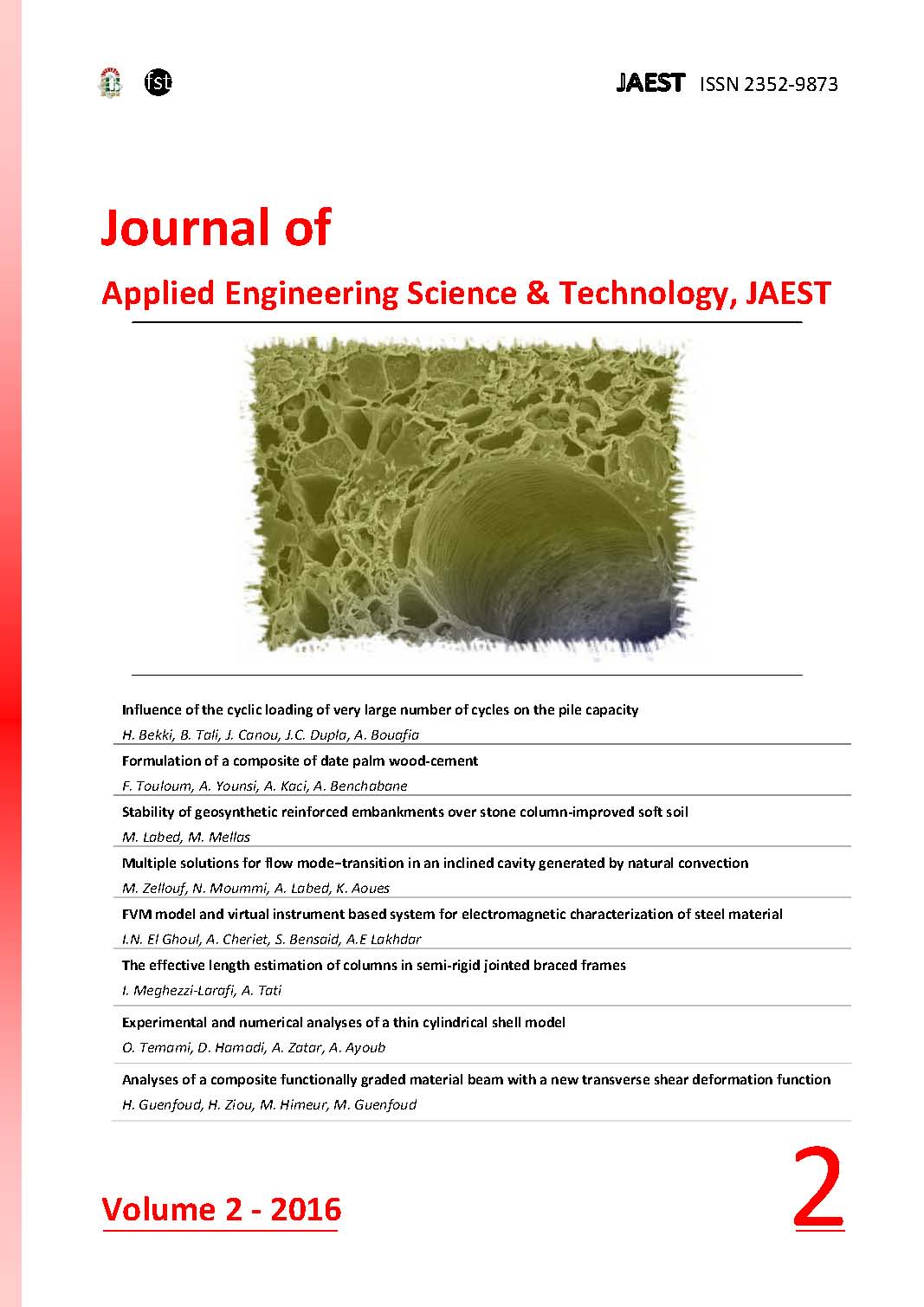
Analyses of a composite functionally graded material beam with a new transverse shear deformation function
 View 1063/
 482
DOI:
https://doi.org/10.69717/jaest.v2.i2.43Keywords:
Functionally Graded Material, Power-law, Finite Element Method, Timoshenko’s beam, Shear functionAbstract
In the present paper, we offer a higher-order shear deformation theory for bending of functionally graded beam. A new polynomial shear function is used which satisfies the stress-free boundary conditions (exact boundary conditions on the stress) at both, top and bottom surfaces of the beam. Hence, the shear correction factor is not necessary. Additionally, the present theory has strong similarities with Timoshenko beam theory in some concepts such as equations of movement, boundary conditions and stress resultant expressions. The governing equations and boundary conditions are derived from the principle of minimum potential energy. Functionally graded material FGM beams have a smooth variation of material properties due to continuous (unbroken) change in micro structural details. The variation of material properties is along the beam thickness and assumed to follow a power-law of the volume fraction of the constituents. Finite element numerical solutions obtained with the new polynomial shear function are presented and the obtained results are evaluated versus the existing solutions to verify the validity of the present theory. At last, the influences of power law indicator and the new shear deformation polynomial function on the bending of functionally graded beams are explored.
Downloads
Downloads
Published
Issue
Section
License

This work is licensed under a Creative Commons Attribution-NonCommercial 4.0 International License.
Copyright and Licensing Terms
Journal of Applied Engineering Science and Technology (JAEST)
Effective September 2026, JAEST adopted the Creative Commons Attribution 4.0 International License (CC BY 4.0) for newly published articles.
Under this license, readers may share, distribute, reproduce, adapt, and reuse published articles, including for commercial purposes, provided that appropriate credit is given to the original authors, the license is linked, and any changes are indicated.
Authors retain copyright of their work and grant JAEST the right of first publication.
Current Publication License: CC BY 4.0
Note on previously published articles: Articles published before September 2026 remain subject to their originally applicable licensing and copyright terms unless a change has been authorized by the respective rights holders. The current CC BY 4.0 policy does not automatically relicense previously published content.
For complete information, consult the JAEST Open Access Statement .