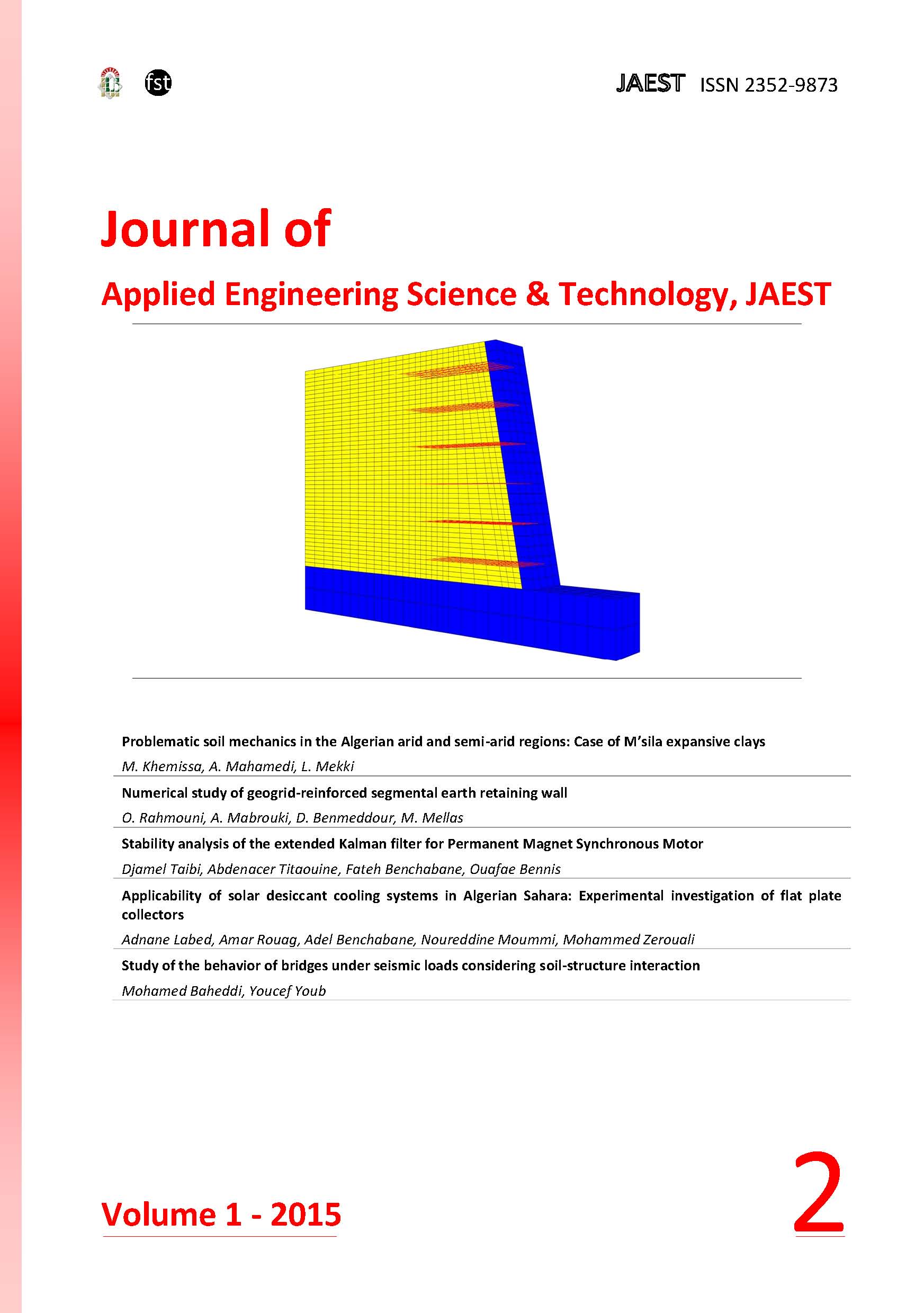
Stability analysis of the extended Kalman filter for Permanent Magnet Synchronous Motor
 View 659/
 58
DOI:
https://doi.org/10.69717/jaest.v1.i2.16Keywords:
Permanent magnet synchronous machine, Direct filed oriented control, Extended Kalman filter, EstimationAbstract
This paper presents a sensorless direct field oriented control fed interior permanent magnet synchronous motor (IPMSM) by using a known mathematical tool. The Kalman filter is an observer for linear and non-linear systems and is based on the stochastic intromission, in others words, noise. It is a question of studying the state and measurement noise covariance matrices Q and R on the stability of the Extended Kalman Filter. This last is used for the d, q stator current, mechanical speed, rotor position, stator resistance and the load torque estimation. The simulation tests carried out on Matlab Simulink showed that the matrix R improves much more quality of the estimated states while the matrix Q allows the improvement of the estimation process convergence.
Downloads
Downloads
Published
Issue
Section
License

This work is licensed under a Creative Commons Attribution-NonCommercial 4.0 International License.
Copyright and Licensing Terms
Journal of Applied Engineering Science and Technology (JAEST)
Effective September 2026, JAEST adopted the Creative Commons Attribution 4.0 International License (CC BY 4.0) for newly published articles.
Under this license, readers may share, distribute, reproduce, adapt, and reuse published articles, including for commercial purposes, provided that appropriate credit is given to the original authors, the license is linked, and any changes are indicated.
Authors retain copyright of their work and grant JAEST the right of first publication.
Current Publication License: CC BY 4.0
Note on previously published articles: Articles published before September 2026 remain subject to their originally applicable licensing and copyright terms unless a change has been authorized by the respective rights holders. The current CC BY 4.0 policy does not automatically relicense previously published content.
For complete information, consult the JAEST Open Access Statement .