Evaluation of Radon-222 concentration and its associated risks in groundwater sources of communities around selected mining sites in Sierra Leone
 View 413/
 0
235
0
235
DOI:
https://doi.org/10.69717/jaest.v6.i1.150Keywords:
Radon-222; Groundwater Contamination; Mining, Health Hazards, RAD7Abstract
Radon-222 in groundwater poses significant health risks through ingestion and inhalation, being the second leading cause of lung cancer deaths in the U.S., with 21,000 fatalities annually. This study evaluated radon-222 levels and associated risks in groundwater near mining sites in Sierra Leone during the rainy season. Fifteen samples from each site – Koidu, Yengema and Marampa, were analyzed using a calibrated DURRIDGE RAD-7 detector. Risks were calculated for infants, children and adults, including annual effective doses, Excess lifetime cancer risks and Lung Cancer Cases per million people per year. The results showed that Radon-222 concentrations in the groundwater samples ranged from 5.07 to 41.63 Bq/l with an average value of 19.10 Bq/l. The total annual effective doses varied from 65.53 to 590.49 (μSv/y), highest in infants. Excess lifetime cancer risks ranged from 0.0002 to 0.0021, with infants at the greatest risk. Lung cancer incidence was approximately 0.0009 per million people per year. Importantly, all samples remained below WHO and EU limits of 100 Bq/l, indicating compliance with international safety guidelines and no immediate health risk. However, 87.5% of samples exceeded USEPA's more stringent maximum contaminant level of 11.1 Bq/l. This discrepancy reflects differing regulatory philosophies : USEPA's precautionary approach versus WHO/EU's risk-based thresholds. While the water meets international standards for safe consumption, the exceedance of USEPA standards suggests potential long-term health concerns warranting continued monitoring, particularly for vulnerable populations such as infants and children. Simple, low-cost mitigation measures such as aeration, storage (allowing radon to decay/escape) and ventilation during water use are recommended where concentrations approach upper limits.
Highlights
1. This study evaluated 222Rn levels and associated risks in groundwater near mining sites in Sierra Leone during the rainy season.
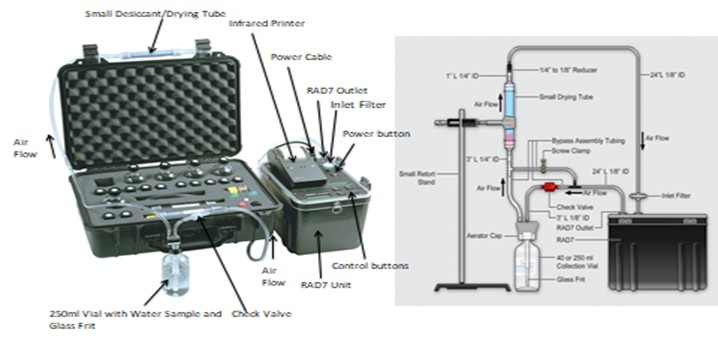
2. Fifteen samples from each site – Koidu, Yengema and Marampa, were analyzed using a calibrated DURRIDGE RAD-7 detector.
3. Risks were calculated for infants, children and adults, including annual effective doses, Excess lifetime cancer risks and Lung Cancer Cases per million people per year.
4. Calculations reveal that the total annual effective doses varied from 65.53 to 590.49 (µSv/y), highest in infants.
5. Elevated 222Rn levels indicate potential long-term health risks for inhabitants, especially infants and children.
Downloads
References
M.S. Alam, M.M. Siraz, A.M. Jubair, S.C. Das, D.A. Bradley, M.U. Khandaker et al., A study on measuring the ²²²Rn in the Buriganga River and tap water of the megacity Dhaka, PLOS ONE 18(5) (2023) e0286267. https://doi.org/10.1371/journal.pone.0286267.
E.G. Vogiannis, D. Nikolopoulos, Radon sources and associated risk in terms of exposure and dose, Frontiers in Public Health 2 (2015) 207. https://doi.org/10.3389/fpubh.2014.00207.
UNSCEAR, Sources and Effects of Ionizing Radiation, United Nations, New York, 2000.
H. Keramati, R. Ghorbani, Y. Fakhri, A.M. Khaneghah, G.O. Conti, M. Ferrante et al., Radon 222 in drinking water resources of Iran: A systematic review, meta-analysis and probabilistic risk assessment, Food and Chemical Toxicology 115 (2018) 460–469. https://doi.org/10.1016/j.fct.2018.03.042.
F.G. Kondev, M. Wang, W.J. Huang, S. Naimi, G. Audi, The NUBASE2020 evaluation of nuclear properties, Chinese Physics C 45(3) (2021) 030001. https://doi.org/10.1088/1674-1137/abddae.
WHO, World Health Organization latest global cancer data, World Health Organization, Geneva, 2018.
V. Duggal, V. Rani, R. Mehra, K. Saini, B.S. Bajawa, Assessment of age-dependent radiation dose and toxicity risk due to uranium ingestion through groundwater, india, Toxicological & Environmental Chemistry (2016). https://doi.org/10.1080/02772248.2016.1196210.
IARC, IARC Monographs on the Evaluation of Carcinogenic Risks to Humans, Vol. 43, Lyon, 1988.
ICRP, Compendium of Dose Coefficients based on ICRP Publication 60, Annals of the ICRP 41(Suppl.) (2012) 1–130.
S. Bello, R. Nasiru, N.N. Garba, D.J. Adeyemo, Annual effective dose associated with radon, gross alpha and gross beta radioactivity in drinking water from gold mining areas of Shanono and Bagwai, Kano state, Nigeria, Microchemical Journal 154 (2020) 104551. https://doi.org/10.1016/j.microc.2019.104551.
A. Ruano-Ravina, K.T. Kelsey, A. Fernandez-Villar, J.M. Barros-Dio, Action levels for indoor radon: different risks for the same lung carcinogen? European respiratory journal, 50(5) (2017) 1701609. https://doi.org/10.1183/13993003.01609-2017.
A.R. Mathloom, M.H. Alkhafaji, A.A. Al-Hachami, The study of determining the levels of radon gas concentrations (soil, water and plants) in the areas exposed to military operations in Suq Al-Shuyoukh district, South of Thi-Qar province, Iraq, Journal of Physics: Conference Series, 1804 (2021) 012146. https://doi.org/10.1088/1742-6596/1804/1/012146.
A.A. Sahar, M.D. Saudi, H.M. Muwafaq, Radon Concentrations Assessment and Effective Dose Estimation in the Buildings of University of Technology/Baghdad, Eng. And Tech. Journal, 32(13) (2014) 3216-3227. https://doi.org/10.30684/etj.32.13A.13.
S.K. Ezzulddin, H.H. Mansour, Assessment of Radon Exposure in Erbil Drinking Water Resources, ZANCO Journal of Pure and Applied Sciences, 29(4) (2017) 184-194. https://doi.org/10.21271/zjpas.29.s4.22.
WHO, Guidelines for Drinking-water Quality: Fourth edition incorporating the first and second addenda, World Health Organization, Geneva, 2022.
USEPA, Radon in Drinking Water: Health Risk Reduction and Cost Analysis, Federal Register 64, Washington, 1999.
A. Aruwa, A.A. Kassimu, P.M. Gyuk, B. Ahmadu, J.O. Aniegbu, Studies on radon concentration in underground water of Idah, International Journal of Research Granthaalayah, 5(9) (2017) 266-275. https://doi.org/10.29121/granthaalayah.v5.i9.2017.2242.
N. Todorovic, J. Nikolov, S. Forkapic, I. Bikit, D. Mrdja, M. Krmar et al., Public exposure to radon in drinking water in SERBIA, Applied Radiation and Isotopes, 70 (2012) 543–549. https://doi.org/10.1016/j.apradiso.2011.11.045.
F.Z. Darabi, M. Rahimi, M. Malakootian, N. Javid, Studying radon concentration in drinking water resources in Zarand city (Iran) and its villages, Journal of Radioanalytical and Nuclear Chemistry, 326 (2020) 33–39. https://doi.org/10.1007/s10967-020-07349-5.
M.M. Orosun, T.B. Ajibola, O.E. Ehinlafa, A.I. Kolawole, B.N. Salawu, S.D. Ishaya et al., Annual Effective Dose Assessment of Radon in Drinking Water from Abandoned Tin and Cassiterite Mining Site in Oyun, Kwara State, Nigeria, Pollution, 8(1) (2022) 181-192. https://doi.org/10.22059/poll.2021.326962.1136.
E.H. El-Araby, H.A. Soliman, M. Ebo-Elmagd, Measurement of radon levels in water and the associated health hazards in Jazan, Saudi Arabia. Journal of radiation research and applied sciences, 12(1) (2019) 31-36. https://doi.org/10.1080/16878507.2019.1594134.
H. Nuhu, S. Hashim, M.S. Sanusi, M.A. Saleh, Radon activity concentration measurements in water sources from Perak State, Malaysia, Journal of radiation research and applied sciences, 13(1) (2020) 665-671. https://doi.org/10.1080/16878507.2020.1820270.
H.K. Shu'aibu, M.U. Khandaker, A. Baballe, S. Tata, M.A. Adamu, Determination of radon concentration in groundwater of Gadau Bauchi State, Nigeria and estimation of effective dose. Radiation Physics and Chemistry, 178 (2021) 108934. https://doi.org/10.1016/j.radphyschem.2020.108934.
S. Suresh, D.R. Rangaswamy, E. Srinivasa, J. Sannappa, Measurement of radon concentration in drinking water and natural radioactivity in soil and their radiological hazards. Journal of Radiation Research and Applied Science, 13(1) (2020) 12-26. https://doi.org/10.1080/16878507.2019.1693175.
A.M. Kamba, I.O. Okunade, Radon measurement in commercial borehole water from some selected areas in Kaduna metropolis using Liquid Scintillation Counter, International Journal of Mathematics and Physics Research, 3(2) (2016) 71-81.
I.M. Kareem, A. Ahmed, R.S. Mohammed, H.R. Abdo, W.Y. Shlaimoon, N.A. Karim, Radiological Risk Assessment of 222 Radon Concentration And Annual Effective Dose Calculation in Ground water From Zakho, Iraq, Journal of Advanced Zoology, 45(2) (2024) 1326-1334. https://doi.org/10.53555/jaz.v45i2.4082.
United Nations, Sources and Effects of Ionizing Radiation, United Nations, New York, 2001.
H. Bem, U. Plota, M. Staniszewska, E.M. Bem, D. Mazurek, Radon (222 Rn) in underground drinking water supplies of the Sourthern Greater Poland Region, Journal of Radioanalytical and Nuclear Chemistry, 299(3) (2014) 1307-1312. https://doi.org/10.1007/s10967-013-2912-1.
V. Duggal, R. Mehra, A. Rani, Analysis of radon concentration in drinking water in Hanumangarh district of Rajasthan, India, Radiation Protection and Environment, 36(2) (2013) 65-70. https://doi.org/10.4103/0972-0464.128870.
G.O. Avwiri, C.P. Ononugbo, I.E. Nwokeoji, Radiation hazard indices and excess lifetime cancer risk in soil, sediment, and water around Mini-Okoro/Oginigba creek, PortHarcourt, Rivers State, Nigeria, Comprehensive Journal of Environment and Earth Sciences, 3(1) (2014) 38-50.
D. Spasic, L. Gulan, B. Vuckovic, Indoor radon testing, effective dose and mitigation measures in a residential house of mining area. Atmosphere, 15(7) (2024) 745. https://doi.org/10.3390/atmos15070745.
A. Azhdarpoor, M. Hoseini, S. Shahsavani, N. Shamsedini, E. Gharehchahi, Assessment of excess lifetime cancer risk and risk of lung cancer due to exposure to radon in a middle eastern city in Iran. Radiation Medicine and Protection, 2, (2021) 112-116. https://doi.org/10.1016/j.radmp.2021.07.002.
Published
Issue
Section
License
Copyright (c) 2026 Journal of Applied Engineering Science and Technology

This work is licensed under a Creative Commons Attribution 4.0 International License.
The Journal of Applied Engineering Science and Technology (JAEST) provides immediate open access to its content on the principle that making research freely available to the public supports a greater global exchange of knowledge.
All articles published in JAEST are licensed under the Creative Commons Attribution 4.0 International License (CC BY 4.0). This license permits users to share, copy, redistribute, adapt, and reproduce the published material in any medium or format, including for commercial purposes, provided that appropriate credit is given to the original author(s) and source, a link to the license is provided, and any changes made are indicated.
Authors retain the copyright of their published work and grant JAEST the right of first publication. Copyright is not transferred to the journal or publisher.
License: Creative Commons Attribution 4.0 International (CC BY 4.0)
License URL: Creative Commons CC BY 4.0